Empowering Women Entrepreneurs to Drive Global Growth
At the World Bank-IMF Annual Meetings, global leaders call for stronger capital access, mentorship, and policy reform to help women entrepreneurs scale their businesses.

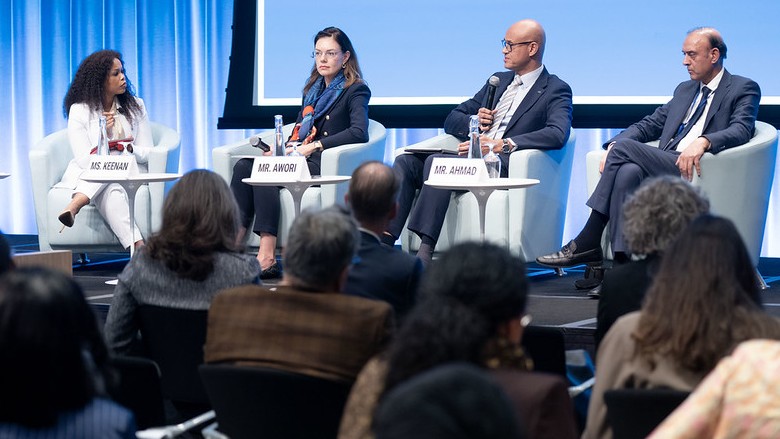
Across Sub-Saharan Africa, more than 80 percent of women are self-employed, running businesses that range from farms and small shops to tech start-ups and creative ventures. Yet, most remain limited by lack of financing and growth opportunities. This issue took center stage at Capital to Scale: Supporting Women Entrepreneurs as Job Creators, a key event during the World Bank-IMF Annual Meetings in Washington, DC. The session explored how the global economy could transform if women-led businesses had the capital and tools to expand and create jobs.
Anshula Kant, Managing Director and World Bank Group CFO, emphasized that investing in women entrepreneurs generates impact that extends far beyond individual livelihoods. “When women get a job or a livelihood, they focus on their families, and families make communities, and communities build societies and countries,” she said. The World Bank Group aims to reach 80 million more women and women-led businesses with capital by 2030.
Mariana Costa, Co-Founder and President of Laboratoria, echoed the importance of inclusion, noting that women must help shape the systems meant to empower them. “If we want a future that really considers the needs of women, we need more women in that field,” she said, highlighting how barriers like care responsibilities and investor bias hinder progress despite women’s proven capabilities.
Jameel Ahmad, Governor of the State Bank of Pakistan, shared how Pakistan’s Banking on Equality strategy increased female bank accounts from 20 million in 2021 to 37 million in 2025. Pakistan also became part of the WE Finance Code, a global initiative under the Women Entrepreneurs Finance Initiative (We-Fi), designed to strengthen women’s access to capital through leadership, data-driven decisions, and inclusive financial systems. Ahmad noted that policies, education, and institutional support must work together to ensure women not only access capital but also thrive.
Charlotte Keenan, Managing Director and Global Head of Goldman Sachs’s 10,000 Women initiative, reinforced that capital alone isn’t enough. “All elements—policy change, system reform, capital, education, mentorship, and networks—need to be present,” she said. Through partnerships with the World Bank Group’s International Finance Corporation (IFC), the Women Entrepreneurs Opportunity Facility has already enabled loans to 267,000 women, mobilizing $3 billion in capital and supporting the creation of over 50,000 jobs.
Jeremy Awori, CEO of Ecobank Transnational, discussed the importance of mentorship, credit history, and tailored financial products. Ecobank made headlines as the first West African bank to issue a gender bond with IFC, aimed at financing women-owned businesses. Through its Ellevate program, Ecobank provides women with training and customized financial solutions to help them grow sustainably. “De-risking and making capital available is a massive step,” Awori said, stressing that even small loans can help women build credit profiles and scale their businesses.
Jasmina Selimović, Governor of the Central Bank of Bosnia and Herzegovina, underscored the power of data in policymaking. Early findings show that women-owned businesses in her country make up just 20 percent of SMEs, yet only 11 percent of non-performing loans are linked to women—proof that women entrepreneurs are strong, reliable borrowers who deserve greater investment.
Moderator Nozipho Tshabalala closed the session with a powerful call to action, reminding participants that access to capital, mentorship, and visibility must go hand in hand. “Capital is catalytic, but it has to be paired with mentoring, capacity building, and visibility. Evidence matters,” she said.
The session’s message was clear: empowering women entrepreneurs is not just about fairness—it’s an economic necessity. With the right support, women can move from survival to success, fueling innovation, job creation, and inclusive global growth.