Women Leaders Unite to Demand Political Reforms
At SDPI-WPC roundtable, women parliamentarians and experts call for urgent legislative action to ensure 33% representation and end tokenism in Pakistan’s political parties.

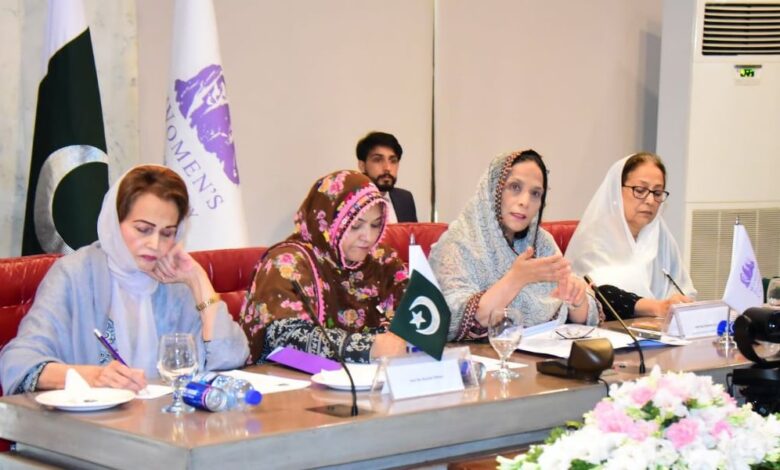
PESHAWAR: Women lawmakers, policy experts, and civil society members gathered at a high-level roundtable titled “Raising Her Voice in Politics”, jointly hosted by the Sustainable Development Policy Institute (SDPI) and the Women’s Parliamentary Caucus (WPC). The event brought together representatives from major political parties including PPP, PML-N, PTI, JUI, and MQM-P to spotlight the ongoing gender gap in political representation and push for legislative reform.
In her opening remarks, MNA Shahida Rehmani, Chairperson of WPC, emphasized that inclusion alone is not enough—empowerment must follow. “It’s a shared goal to not only include women in political parties but empower them to shape their own futures,” she said.
Dr. Rehmani pointed to the weak compliance of the 5% nomination quota under the Elections Act 2017, calling it an example of structural gatekeeping within party systems. “Despite the legal mandate, parties continue to sideline women. We must move toward binding 33% representation in all new political formations,” she added, calling gender policy equality a critical path forward.
SDPI’s research highlights a stark contrast between Pakistan’s demographic reality and political inclusion. With women making up 49% of the population and 59 million registered female voters, their actual influence in decision-making remains minimal. Voter turnout among women also dropped by 5% in the last general election compared to 2018.
An SDPI review of 19 political parties revealed that only five met the 5% nomination requirement. Although parties like BNP and ANP included more women in executive committees—9 and 10 respectively—such examples remain the exception.
SDPI also analyzed the legal framework, pointing out that a 2013 amendment to the Political Parties Order (PPO) 2002 introduced a 5% nomination quota for women, but the 33% representation clause was ignored in legislation. This clause called for women’s inclusion in both elected and non-elected bodies of parties—yet it remains unimplemented.
Qasim Shah, Deputy Executive Director of SDPI, recommended two critical legislative changes: amend Section 208 of the Elections Act 2017 to enforce 33% representation of women in party leadership and Section 202 to ensure at least 33% female membership in political parties at the registration stage.
Parliamentarians present expressed strong support for these recommendations and stressed the need for gender audits, accountability mechanisms, and a move beyond symbolic quotas.
Dr. Abid Qayyum Suleri, Executive Director of SDPI, closed the event by highlighting the global relevance of the issue. “Democracy cannot be inclusive without women leading from the front. It’s time to move from symbolic inclusion to real power-sharing,” he said, referencing the UN’s ongoing male-only leadership history.
PML-N MNA Tahira Aurangzeb echoed the sentiment, stating, “Women should comprise 50% of political parties. They drive inclusivity and development, as seen in Punjab’s success under female leadership.”
The roundtable ended with a strong consensus: Pakistan needs immediate legislative and structural reforms to ensure women are not just included—but truly empowered—to lead.