

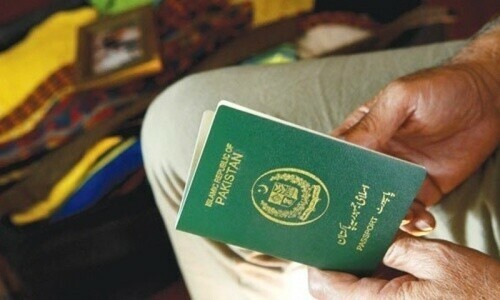
A Pakistani woman married to an Afghan native is allowed to maintain dual nationality even though she carries the Afghan Citizens Card (ACC) or Proof of Registration (PoR), according to a Peshawar High Court ruling.
It further said that those under 21 who were born to Pakistani parents might continue to hold dual citizenship with both Pakistan and Afghanistan until they were 21.
About 65 petitions for various reliefs submitted by citizens of Pakistan and Afghanistan were decided in a historic ruling by a bench made up of Justices Syed Arshad Ali and Wiqar Ahmad.
It also ruled as unlawful the actions of the National Database and Registration Authority, which prevented Pakistani women from obtaining CNICs only because their names were found in ACC and PoR databases, as well as the refusal of B Forms to those under 21 for the same reason.
Pakistanis having ACC and PoR are also declared eligible for CNIC by the court.
The 62-page thorough ruling written by Justice Wiqar Ahmad states that these activities are in violation of sections 14, 14A, and 16 of the Citizenship Act.
According to the bench, the petitioners who were married to Pakistani citizens but were themselves or their spouses citizens of Afghanistan were eligible for the Pakistan Origin Card.
It decided that they could also apply to the Federal Government in the required way for the grant of citizenship through naturalization.
The judgment further stated that Pakistani nationals who received ACC or PoR cards and did not fit into any of the other petitioner categories should apply in the required way to the federal government for a clearance certificate under Section 19 of the Citizenship Act.
It stated that a CNIC should be provided to them and their ACC or PoR cards should be canceled upon the issuance of a clearance certificate regarding their Pakistani citizenship.
The petitions pertaining to obtaining Pakistani citizenship by descent accounted for the majority of the cases. These included people who had obtained an ACC or PoR card, married an Afghan citizen, or had children born to a marriage consisting of both Pakistani and Afghan parents.
In accordance with the Citizenship Act of 1951, petitioners’ attorneys Saifullah Muhib Kakakhel and Nouman Muhib Kakakhel contended that the instances of their clients were pertinent to citizenship by descent.
It was mentioned that a number of Pakistani nationals obtained ACC or PoR cards solely in order to get food or relief payments as low-income individuals; nevertheless, they are currently unable to have those cards revoked.
The legal team also supported the court in addressing the legal issue of a Pakistani lady married to a foreign national being able to keep both of her citizenships—that of her parents and her spouse.
They said that these people’s CNICs and passports were blocked just for having Afghan passports, ACC cards, or PoR cards.
The bench addressed the Citizenship Act, the Nadra Ordinance, and higher court rulings in the verdict.
The cases were split up into four groups. They included Afghans seeking PoR or citizenship who were married to Pakistani citizens, Pakistani citizens who were mistakenly declared Afghan citizens and issued ACC cards, and children born to Pakistani and Afghan parents who had an ACC or PoR Card issued in their names—all of whom are entitled to dual citizenship.
The bench rendered its decision after debating various sections of the Citizenship Act, concluding that a female Pakistani citizen who marries an Afghan citizen can continue to hold her dual nationality. In the same way, offspring born into such marriages are entitled to keep both their Afghani and Pakistani nationalities until they become 21.
“Just because they possess an ACC or a PoR does not entitle them to citizenship status as citizens of Pakistan.” As such, their entries in the Nadra database and other Pakistani government databases may coexist. Since the identities of these individuals had been discovered in the Afghan Citizenship data or they were discovered to be PoR holders, their CNICs, assuming they had already been issued, could not be banned.
The court decided that even if these women and children had ACC or PoR cards, they could still hold Pakistani CNICs.
“Even though they have been recognized as holders of PoR or ACC, these children will be eligible to obtain Pakistani citizenship through the issuance of Form B,” the ruling stated.
The bench decided that the federal government should set up a system for handling applications from Pakistani nationals who obtained ACC and PoR cards because it was widely known that many of them had registered as Afghan citizens in order to receive aid from foreign donors.
“The applications will be considered and determined expeditiously, taking into account that some state citizens are also experiencing hardships and their complaints must be addressed expeditiously,” the statement stated.