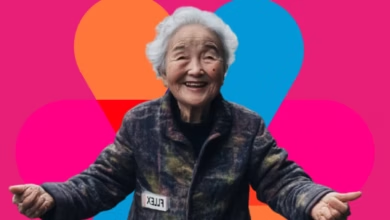

“I’m ninety years old?” The day I told my mother she had reached this extraordinary birthday milestone, she let out a horrifying cry. She urged me to keep quiet about what she perceived to be a fate worse than death, saying, “Ooooh, don’t tell anybody!” She was stubborn enough to make sure that no one ever found out her true age, even though her memory was already failing to the point where she could no longer tell what day, month, or year it was.
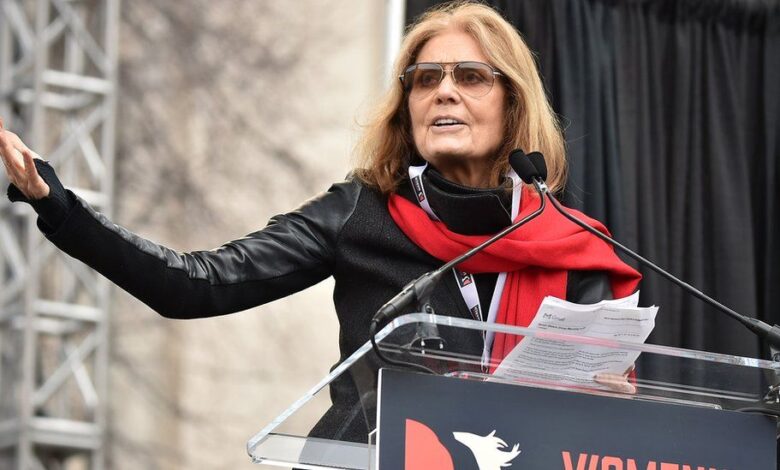
And that brings me to a well-known quotation from feminist icon, author, and activist Gloria Steinem. Fifty years ago today, on her 40th birthday, she witty replied to a reporter’s complimentary remark that she “didn’t look forty” by saying, “This is what 40 looks like.” We’ve been lying for a very long time, so who knows?
Gloria’s remarks have previously functioned as counterbalances to my mother’s perspective—as well as to numerous other perspectives that women in her generation were indoctrinated with.
Therefore, I will refrain from complimenting Gloria Steinem on how she still doesn’t look her age or how wise, brave, and considerate she is on this day as she turns 90. Instead, I would like to honor her and the feminist cause to which she has dedicated her long life. She has made it possible for me and many other members of my generation to, in her own words, “Live out the unlived lives of our mothers, because they were not able to become the unique people they were born to be.”
But I’m now faced with a dilemma. Gloria told me, in her typically gracious and modest way, that too much had already been written about her and urged me to write about other feminists when I told her I wanted to write a book about her. That being said, how can I honor Gloria on her birthday without making it solely about her? Once more, I discovered the remedy in one of her well-known quotations:
Most authors start their writing with a statement about someone else, and it ends there. Self-discovery is a lifelong process for talented writers.
Luckily, Gloria’s principles have always been a part of my own self-knowledge journey, so I get to do both.
A year after Ms. made her debut, in 1973, I was 13 years old. At that age, filled with upheaval, confusion, and turmoil, I felt free to connect with my true self for the first time, acting as a bridge between a young girl’s innocence and the ensuing teenage angst. That angst can easily become agony for girls who believed, behaved, and dreamed differently than their peers of a similar age—at least, it did for me.
Girls were forced into complacent roles by the traditional values of the 1960s and early 1970s, which included the popular card game Old Maid (“be careful not to be left with the Old Maid card, or you’ll end up unmarried and alone forever”), the popular sport of hopscotch (“don’t move more than one of your two feet, or you’ll lose”), and the preferred clothing item of knee-length dresses (ideally accessorized with patent leather Mary Janes that should, just like your legs, never show a scratch).
I was a complete failure at all of these, preferring to wear muddy baseball cleats (which I proudly wore both on and off the field), collect baseball cards (which I stole covertly from my older brother’s collection), and catch footballs from a distance (which required the use of both feet). However, nobody understood me—not a single neighbor, classmate, or relative.
Gloria once remarked, “If we are alone for a long time, we start to feel uncertain or wrong.” And like a beloved family nickname, it was that one word, “wrong,” that my parents used to describe me every day.
Indeed, words have power, but they also have the ability to heal in addition to harming.
Actually, I learned how to use writing to “find out about myself” just like she did from that very first issue of Ms. and from Gloria’s first piece that was published within.
In “Sisterhood,” Gloria described how she felt like she had had “a revelation… as if I had left a small dark room and walked into the sun” after she discovered a group of strong women in the feminist movement. She found it to be “contagious and irresistible,” and she learned that she would never “[feel] like I don’t exist… I am continually moved to discover I have sisters” unless she joined a sisterhood, in which “women get together with other women that we’ll ever find out who we are.” With those words, “I am beginning, just beginning, to find out who I am,” she concluded the piece.
Thus, fifty years later, instead of focusing on Gloria’s youthful appearance, reporters now ask the seasoned activist, “Who will you be passing your torch to?” Gloria continues, “I’m not giving up my torch, but using it to light the torches of others, because if we each have a torch, there’s a lot more light,” in a way that will inform and empower others.
And this, in the most enlightened sense, is how 90 looks.