Pakistan’s Polio Battle: Women Frontline Workers Push Back Against Resistance in Balochistan
Female vaccinators like Bibi Hajjira risk stigma, fatigue, and even threats in Pakistan’s toughest districts, but their persistence is driving progress toward eradicating the crippling disease.

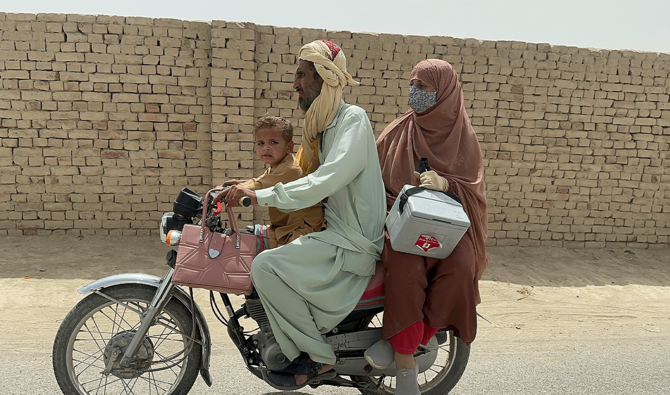
In the rugged, sun-scorched landscapes of Killa Abdullah, Balochistan, 30-year-old Bibi Hajjira rises each morning with a mission that could alter the future of her community. Wrapped in a scarf and embroidered mask, she rides alongside her husband and toddler to reach remote villages where vaccine refusals have kept Pakistan among the last two countries still battling endemic polio. Her task is deceptively simple yet profoundly challenging: persuading hesitant mothers to let their children swallow two drops of the oral polio vaccine.
For Hajjira, the job demands more than endurance; it requires persuasion in a place where myths, mistrust, and cultural barriers have long undermined vaccination drives. “Convincing families feels like trying to convert someone’s beliefs,” she admits. Yet, she persists, moving house to house under the harsh Balochistan sun, driven by the belief that every child vaccinated is a victory against a disease that still cripples lives.
Pakistan launched its fourth national anti-polio campaign of 2025 earlier this month, aiming to reach nearly 29 million children. Encouragingly, the country has reported 24 cases so far this year, a steep decline from 74 in 2024. Still, with polio endemic in both Pakistan and neighboring Afghanistan, progress remains fragile. Years of effort have been undone in the past by misinformation, militant violence, and logistical hurdles. Since 2012, nearly 100 polio workers and security personnel have been killed in targeted attacks, particularly in Balochistan and Khyber Pakhtunkhwa.
In such a hostile environment, women like Hajjira are indispensable. According to the National Emergency Operations Center, almost 60 percent of polio vaccinators in Balochistan are women. Cultural restrictions often bar men from entering homes, but female health workers can connect with mothers, engage them in conversation, and reassure them about the safety of the drops. Without these women, entire pockets of the province would remain out of reach.
Progress is becoming visible. Last year, Balochistan accounted for 27 of Pakistan’s polio cases. In 2025, the province has reported none so far. Environmental samples — crucial in detecting virus circulation — show improvement too. Just one out of 23 samples in July tested positive, a dramatic drop that health officials say reflects the effectiveness of intensified campaigns. “The female polio workers have been providing good support, especially in hard areas of the province,” said Inam ul Haque, provincial coordinator for Balochistan’s Emergency Operations Center.
Yet challenges persist. Vaccine refusals are still common, rooted in misinformation, poverty, and even domestic threats. Some mothers tell Hajjira their husbands have warned them with divorce if they allow vaccination. She meets these obstacles with patience and persistence, seeing her role as a long-term effort to shift community mindsets. “This is a struggle, and no work succeeds without struggle,” she says. “If even one child is vaccinated because of our efforts, it is a great success.”
Her husband, once skeptical, now supports her mission after witnessing the long-term suffering of children disabled by polio in their village. “I see this as an act of goodness now,” he says, acknowledging how stigma once clouded his view.
Local communities are also changing. Villagers like Muhammad Rahim say women vaccinators have helped break down refusals in Killa Abdullah. “Now people are more aware of the benefits,” he explains. Hajjira herself has convinced families to vaccinate nearly 800 previously “hidden children” — those whose parents had refused.
Still, she recognizes how rare it is for women in her district to work in this field, given cultural restrictions and security fears. She hopes more will join, knowing that collective effort is essential to eliminating polio once and for all. “We endure negative attitudes, insults, and even humiliation,” she admits. “But I keep persuading families, hoping that once their thinking changes, their attitudes will change too.”
In Balochistan’s dust and heat, amid resistance and risk, women like Hajjira embody Pakistan’s polio fight: resilient, determined, and quietly transformative. Their work is not just about vaccines — it is about reshaping attitudes, protecting futures, and inching the country closer to finally eradicating a disease that has clung on for far too long.