Pakistan Raises Voice for Kashmiri and Palestinian Women at UN Security Council
Pakistan urges global action on human rights violations against women in Indian Illegally Occupied Jammu and Kashmir and Palestine.

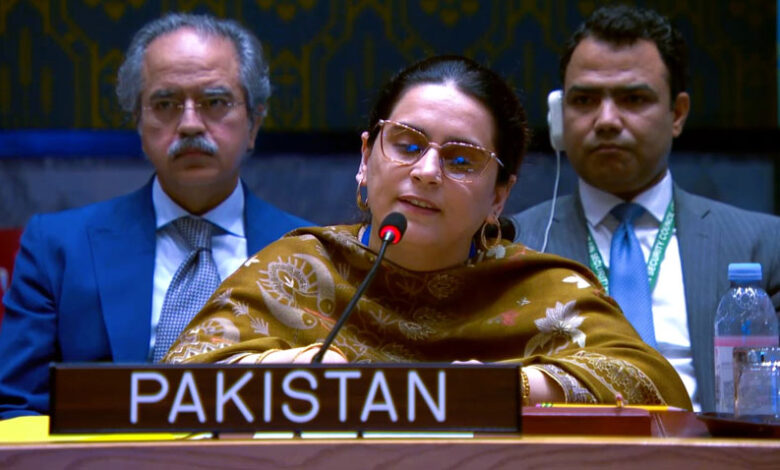
At the United Nations Security Council, Pakistan has once again highlighted the ongoing suffering of women in Indian Illegally Occupied Jammu and Kashmir (IIOJK) and Palestine, calling on the international community to recognize their plight and ensure justice for decades of human rights violations.
Speaking during the UN Security Council’s open debate on Women, Peace, and Security, Counsellor Saima Saleem from Pakistan’s Mission to the United Nations expressed deep concern over the continued silence of the global community regarding the grave injustices faced by women in conflict zones. She particularly regretted that the UN Secretary-General’s latest report failed to include any reference to the situation of Kashmiri women, who have been victims of severe violence and systemic oppression under the ongoing occupation.
Saima Saleem emphasized that in Indian Illegally Occupied Jammu and Kashmir, women have endured decades of trauma, including sexual violence, arbitrary detentions, and psychological abuse. She noted that such violence has been deliberately used as a weapon of war to break the spirit of the Kashmiri people and suppress their legitimate demand for self-determination. “The women of Kashmir have faced unimaginable suffering, yet their voices remain unheard in international forums,” she said. “Their resilience and courage deserve recognition, and the perpetrators of these heinous crimes must be held accountable.”
Drawing parallels with the situation in Palestine, Pakistan’s representative stated that women in Gaza and the West Bank continue to face relentless violence, displacement, and the denial of basic human rights due to the ongoing Israeli occupation. She stressed that the continued disregard for women’s security and dignity in these regions undermines the principles of international law and the UN Charter.
“The pain of Kashmiri and Palestinian women is not isolated—it represents the collective failure of the world to protect women in conflict situations,” Saima Saleem asserted. She urged the Security Council to take meaningful steps toward implementing its own resolutions on Women, Peace, and Security, particularly by ensuring that women in occupied territories are protected from violence and given access to justice and rehabilitation.
Responding to the remarks made by the Indian delegate during the session, Pakistani representative Sarfraz Ahmad Gohar strongly criticized India’s attempts to divert attention from its own human rights abuses. He stated that the Hindutva ideology has now become a state policy in India, fostering an environment of religious intolerance and systematic persecution of minorities.
“Under the current Indian government, Muslims, Christians, Dalits, and other marginalized communities are being targeted with impunity,” Gohar said. “The Indian state’s discriminatory actions are no longer limited to rhetoric—they are reflected in violent crackdowns, unjust laws, and the suppression of dissent.”
He further added that India’s occupation of Jammu and Kashmir remains one of the world’s most egregious examples of state-sponsored oppression, where fundamental freedoms are consistently violated, and the right to self-determination is denied through force.
Pakistan reiterated its long-standing position that peace and stability in South Asia cannot be achieved without resolving the Kashmir dispute in accordance with UN Security Council resolutions and the wishes of the Kashmiri people. The Pakistani delegation also reaffirmed its commitment to standing in solidarity with the people of Palestine and Kashmir until their struggles for freedom and justice are realized.
In conclusion, Pakistan urged the international community, especially the United Nations, to uphold its moral and legal responsibility by taking concrete actions to protect women in conflict zones, ensure accountability for perpetrators, and restore dignity to those who have suffered for generations under occupation and violence.