Lighting the Way: How Women Electricians Are Changing Pakistan
Women electricians in Karachi’s Roshni Baji program are transforming lives, ensuring safety, and proving that skilled trades are for everyone—breaking barriers in Pakistan’s male-dominated energy sector.

In the heart of Karachi’s Shah Latif Town, a simple cardboard sign reads, “Electrician Available.” It lists the expertise of an electrician skilled in repairing sewing machines and water pumps, along with a phone number. What it doesn’t reveal is that the electrician isn’t a man—it’s Nazia Seher, a 30-year-old mother of three. Her husband’s number is listed instead, as society isn’t always ready for a female electrician.
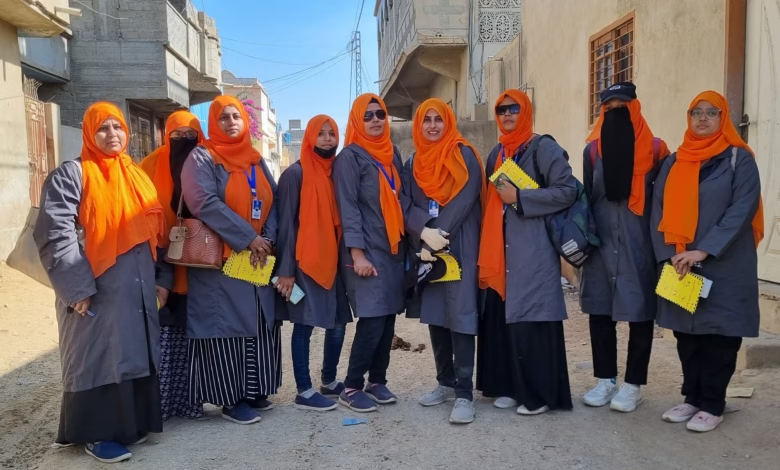
Seher is one of 200 women trained under Karachi’s Roshni Baji (Light Sisters) initiative, a pioneering program by a private electricity firm that equips women with skills in meter reading, electrical repairs, and solar panel installations. Launched in 2021, this initiative aims to challenge Pakistan’s male-dominated energy sector, where women make up just 4% of the workforce.
Empowering Women Through Work
The program’s impact is life-changing. “Getting selected for the training was a blessing,” says Seher. “My husband lost his job during the pandemic, and the paid internship helped us survive.” Today, she reads nearly 200 electric meters a day using a digital device that transmits data online.
Her role as a meter reader and technician has reshaped traditional gender roles at home. Seher’s husband, Mohammad Rehan, a textile worker, now takes on household chores. “A few years ago, making tea and sweeping floors was unthinkable for me. Now, I chop vegetables while she works,” he admits. Their relationship has improved, with financial stability bringing newfound peace.
Beyond meter reading, Seher repairs household appliances, installs backup batteries, and assists neighbors—especially women who are uncomfortable letting male electricians into their homes. Noor-un-Nisa Israr, a single mother, appreciates Seher’s help. “I work long hours and can’t have strange men in my house. Nazia’s expertise is a blessing.”
From Training to Real-World Impact
Seher’s growing reputation has made her a trusted name in Karachi’s Cattle Colony. When homemaker Razia Asghar needed a solar panel installed, Seher took on the challenge. “We only learned solar installation in theory, but I applied my knowledge practically. Now, more families are reaching out,” she says.
Operating in conservative, purdah-observing communities has given women electricians a unique advantage. “People trust us because we are women,” Seher explains. “Word of mouth is crucial in building a career in this field.”
Fighting Challenges and Stereotypes
Not everyone welcomes women in electrical work. “A man once loudly questioned if there were no male electricians left in Pakistan,” Seher recalls. “I wanted to respond, but I let it pass.”
Despite such resistance, the Roshni Baji program has made a significant impact, reaching 800,000 households in just four years. Each female technician visits around 35-40 homes daily, educating families about electrical safety while offering repairs.
Tackling Pakistan’s Electricity Crisis
Pakistan’s energy sector is fraught with hazards, especially in informal settlements where illegal power connections (kundas) are widespread. These metal hooks, used to tap into main power lines, cause electrocution risks and fires.
Durdana Shoaib, another Roshni Baji graduate, joined the program after a personal tragedy. Her daughter suffered severe burns after touching a live transformer. “We were negligent, but now I educate others to prevent such accidents,” she says.
Last year, K-Electric removed over 250,000 kundas across Karachi—nearly 350 tonnes of illegal wiring. In 2024, 7,000 unauthorized connections in Bin Qasim Town were replaced with legal meters, reducing electricity theft and improving safety.
A Brighter Future for Women in Energy
Women like Seher and Shoaib are reshaping Pakistan’s energy landscape. They are proving that electricity is not just a man’s domain, and their work is creating safer communities. By challenging norms, they are not just lighting homes—they are lighting the way for future generations of women in STEM and technical fields.
The journey is far from over, but one thing is clear: women electricians in Pakistan are here to stay, breaking barriers one circuit at a time.