
UK Parliament Hosts Pakistan’s Women MPs to Advance Leadership and Gender Equality
A high-level WPC delegation visits London, strengthens parliamentary cooperation, and signs a joint commitment to promote women’s rights and inclusive governance.

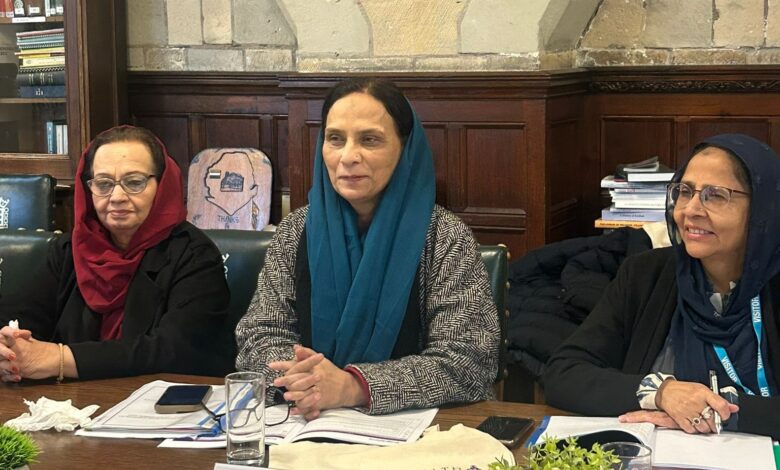
The UK Parliament welcomed a delegation from Pakistan’s Women’s Parliamentary Caucus (WPC) from 25–27 November 2025, marking a major step toward enhancing women’s political participation and strengthening bilateral cooperation. Led by WPC Secretary Dr. Shahida Rehmani, MNA, the delegation engaged UK lawmakers on gender equality, parliamentary reforms, and shared strategies for inclusive governance.
According to the official press release, the three-day visit focused on peer learning and cross-party collaboration. A key highlight was the signing of a Joint Communique with Baroness Harriet Harman KC, reaffirming a shared commitment to advancing women’s leadership, promoting equality laws, and countering gender-based discrimination.
The delegation presented a wide range of policy insights during their sessions with British parliamentarians. Dr. Rehmani and Ms. Nikhat Shakeel Khan opened discussions by outlining Pakistan’s parliamentary functioning and the WPC’s structure. Their briefing gave UK MPs a clear view of how women legislators in Pakistan collaborate across party lines to advance gender-sensitive reforms.
Ms. Saira Afzal Tarar spoke on the importance of cross-party consensus, stressing that collective political will is essential for sustainable legislative progress. Syeda Nosheen Iftikhar addressed challenges faced by newly elected women MPs, including political pressures, limited visibility, and barriers to constituency engagement.
Other members shared specialized expertise. Ms. Mussarrat Asif Khawaja discussed parliamentary ethics and standards. Ms. Naeema Kishwar Khan introduced evidence-gathering and data-driven approaches used in Pakistan’s legislative procedures. Ms. Mahtab Akbar Rashdi highlighted the growing concern of online harassment and violence against women in politics, calling for stronger global cooperation to tackle digital abuse.
Gender-responsive budgeting — a key theme of Pakistan’s recent parliamentary initiatives — was discussed in detail by Ms. Tahira Aurangzeb and Dr. Rehmani. They emphasized how inclusive budgeting models help governments allocate resources more effectively and address gender disparities in development sectors.
The delegation included senior MNAs:
Dr. Shahida Rehmani, Ms. Tahira Aurangzeb, Ms. Mahtab Akbar Rashdi, Ms. Naeema Kishwar Khan, Ms. Mussarrat Asif Khawaja, Ms. Saira Afzal Tarar, Syeda Nosheen Iftikhar, Ms. Nikhat Shakeel Khan, and Ms. Minail Khan, Chief Technical Advisor to the National Assembly.
Ms. Minail Khan briefed UK parliamentarians on the evolution of Pakistan’s Women’s Parliamentary Caucus — from its initial foundations under Pakistan’s first female Prime Minister to its formal establishment in 2008 during the tenure of the country’s first female Speaker. She highlighted how the WPC has grown into one of South Asia’s strongest platforms for gender-focused legislative action.
UK Parliamentarians praised the Pakistani delegation for its commitment to democratic strengthening and women’s empowerment. They noted that Pakistan’s WPC model offers a strong example for other democracies and expressed interest in forming a similar caucus within the UK Parliament. Lawmakers described the visit as an “inspiring example of inclusive governance in action.”
The visit concluded with the signing of a Joint Communique, committing both sides to:
promote women’s political participation,
advance gender equality legislation,
combat discrimination and violence,
support access to healthcare and education for women and girls, and
build long-term parliamentary cooperation focused on empowerment and reform.
Speaking at the conclusion of the visit, Dr. Rehmani said the exchange demonstrated the value of peer-to-peer dialogue between democracies. She emphasized that both parliaments share the goal of strengthening women’s leadership and building more inclusive legislative systems.
The delegation’s visit marks a milestone in UK–Pakistan relations and sets a strong global example of how parliamentary partnerships can drive progress on gender equality, representation, and democratic development.