The Wheel of Life: How a Straightforward Tool is Making Thari Women’s Most Difficult Task “Getting Water” Easier

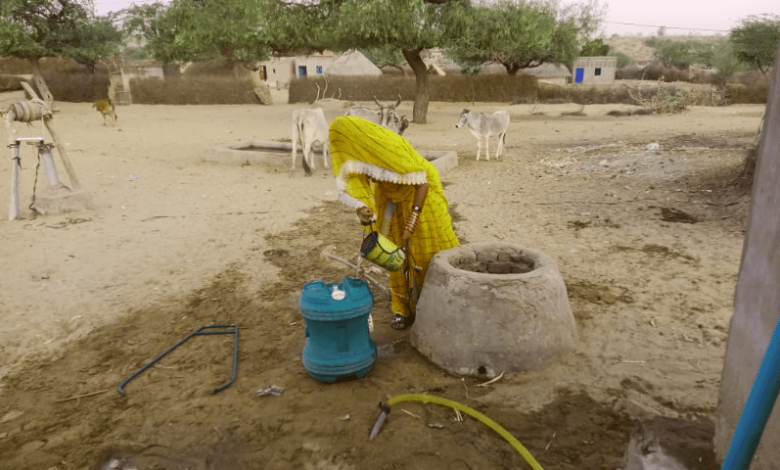
Issiya Begum walks five kilometres barefoot every day to fetch water in the stark desert of Tharpakar, where desolate dunes stretch across thousands of miles and living things are a sight for sore eyes.
She has a permanent disability caused by the water, which is typically replaced with life. Specifically, her back is bent. A few years ago, Issiya Begum was carrying clay pots filled with water from the nearby well to her residence when the incident happened.
Issiya, like other Thari women, is responsible for obtaining water for her home. But eventually, her weak back gave out and permanently gave in to the weight. But that didn’t stop her from “fulfilling her responsibility,” and the difficult trips go on every day.
According to studies, 72% of Pakistani women, particularly those living in rural areas, are in charge of carrying household water, and they dedicate almost three-quarters of their day to this task. These ladies’ livelihoods as well as their physical and mental well-being are impacted by their nearly nine-hour workday without a day off.
These gender-specific obligations steal young girls’ already diminishing opportunities for an education. Since water is essential to life, the women of Thar and other areas facing a water crisis have accepted that they have no other option.
However, the “inhumane practice” of fetching water deeply troubled Nida Sheikh, a behavioural science graduate and the CEO of Tayaba Organisation, who was inspired to turn hardship into opportunity when she visited the area.
Wheeled water
Sheikh first travelled to rural Punjab and Sindh for a project centred on female entrepreneurship. But by the end of the journey, she had noticed a pattern: most women couldn’t even stop to nap or mingle while searching for water.
She told Dawn.com, “I encountered marginalised women in most of these areas who were walking for kilometres and spending hours only to fetch a basic need.” “These women have to carry those pots back home after extracting water from 200–250 metre deep wells, even after they arrive at their destination.
On certain days, they undertake several such trips in a single day. The toll this entire process takes on their bodies and minds is unfathomable, Sheikh said. “I was saddened to learn that, although I took clean water for granted, women in my own country had to fight every day to collect water.”
She would return home from each visit feeling even more uneasy. She later ran into her classmate Bilal Bin Saqib, who was instrumental in founding the Tayaba Organisation. He told her about the creative idea of water barrels that he had come across while travelling through Africa, and they talked about the effort to duplicate a similar solution to alleviate the millions of people in Pakistan who struggle with transportation.
The non-profit Tayaba Organisation created the H2O, or “Help 2 Others,” Wheel—a water-carrying tool that relieves the load from the women’s shoulders—after a number of prototypes and extensive community engagement.
The H2O Wheel is made of UV-stabilized polyethene and has a firm handle for control over rough and rocky terrain. It essentially allows water to be carried inside a wheel that resembles a gallon. It also has a water-storage hole that can be sealed.
Water enough to sustain a family of seven for at least three days can be stored in the approximately 40 kg weight of the wheel. “Once the H2O Wheel was ready, we presented it to friends and family, and Tayaba Organisation was able to find an anonymous donor who has continued to support us to this day,” Sheikh stated.
As a trial project, the NGO first gave out a few hundred wheels informally. “We started by speaking with women to learn about the different problems they encountered while obtaining water.
Over 30,000 H2O Wheels have been given to women in Khyber Pakhtunkhwa, Balochistan, Sindh, and Punjab by the organisation thus far. Sheikh continued, “The wheel has undergone several modifications over the years, all of which have been based on the suggestions of the beneficiaries.”

Transforming Lives
Sughri Ratan, who lives in the Chachro tehsil of Tharparkar’s Bhadari village, used to walk seven hours a day to and from her home in order to fetch water until four years ago.
“We needed at least three to four clay pots for our daily usage… and sometimes even that wouldn’t be enough,” the woman stated to Dawn.com. It is equivalent to carrying at least 10 kg of water every day to carry three pots full to the brim.
Sughri was exhausted from the tiresome exercise, both mentally and physically.
When Sughri received the H2O Wheel for the first time in 2022, she wasn’t entirely convinced it would function. However, these tools were a huge help once we figured out how to use them. The relief of not having to walk and carry heavy loads is known as paidal na chalna ka sukoon, wazan na uthane ka sukoon.
“We can now easily gather water for cooking, cleaning, bathing, and other uses for three days in a row,” the woman remarked.
Most importantly, though, Sughri’s household now has money because she can now use the time she used to spend fetching water to stitch instead of buying wheels and water. “The amount has doubled; previously, we would prepare two to three pieces per month,” she stated.
Kenku and Teejan, Sughri’s neighbours, related a narrative that was comparable.
Organisation Tayaba
In collaboration with the Sami Foundation in Sindh, the Tayaba Organisation has been able to provide more than 2,000 H2O Wheels to areas affected by floods and drought, including Dadu and Umerkot.
According to Suresh Kumar, the foundation’s spokesperson, “there is high demand and requests from women living in surrounding villages for the provision of these wheels as well.”
According to an Ipsos evaluation of the H2O Wheels from 2022, the availability of water in Tharparkar and Umerkot improved the health and hygiene of both adults and children, with a 35 percent increase in the frequency of handwashing.
“Access to safe water has also resulted in a 39 percent reduction in disease incidence among adults and a 31 percent reduction in disease incidence among children,”
In addition, women’s earnings increased by an average of Rs3,000 because they now had more time for hobbies like handicrafts.
Men played a much larger role in carrying water, especially in Umerkot. “Women, particularly those who are pregnant, nursing, or elderly, can ask their male family members to share the workload with them,” the report emphasised.
Women were also able to socialise more because they had more time on their hands, which improved their psychological health and general wellbeing.
Better Times Ahead
The Tayaba Organisation has launched several other projects in addition to H2O Wheels, such as the installation of portable restrooms, the distribution of reusable sanitary napkins, and H2O Air, a device that resembles a dispenser and can generate water through humidity and precipitation.
Sheikh elaborated, saying that Tayaba Organisation adheres to the Maslow pyramid theory, which holds that human behaviour is driven by a hierarchy of needs that moves from basic to complex and aims to elevate marginalised women. “In all these projects, we follow a natural and organic process based on the communication with the people who are in the heart of the water crisis,” Sheikh said.
But the journey hasn’t always been simple; there have been times when Sheikh has felt alone and overpowered by the difficulty of the tasks at hand. International recognition at this time benefited her organisation as well as herself.
She was named one of the top ten recipients of the $500,000 LEAD 2030 fund for Sustainable Development Initiatives from One Young World last year. She will be able to put creative ideas like the H2O Wheels and solar water facilities into practice with the aid of the award money.
Sheikh claims that this will benefit Tayaba Organisation because there is still a great deal of work to be done, particularly since Pakistan is at serious risk of experiencing a water shortage in the near future.
“Life is in the water! It is a resource that is necessary for survival. A person is given a chance at life when they are given access to water, the speaker stated.