
South Africa Faces Rising Outcry Over Gender Violence
Women’s groups launch nationwide shutdown as calls grow to declare GBV a national disaster across the country

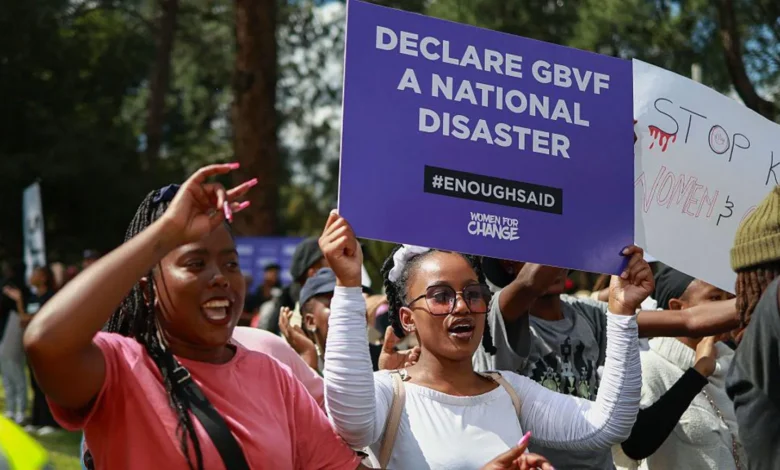
South Africa is witnessing a powerful wave of outrage as women’s rights groups demand urgent national action against gender-based violence. With attacks on women reaching alarming levels, activists are calling for gender-based violence to be declared a national disaster. Their campaign, sparked online and strengthened by viral solidarity, is building toward a nationwide shutdown aimed at forcing the government to confront a crisis that has taken far too many lives. Celebrities, citizens, and communities across the world are joining in by turning their profile pictures purple, symbolizing their commitment to ending one of the country’s most persistent threats against women.
The statistics tell a devastating story. South Africa records some of the highest levels of gender-based violence anywhere, with the rate of women killed being five times higher than the global average. Between January and March alone, 137 women were murdered and more than a thousand were raped. These numbers reflect not only violence but deep systemic failures. Women’s groups argue that the country has normalized this violence to the extent that many survivors feel unseen, unheard, and unsupported. The shutdown on Friday is meant to disrupt this silence. Women are being encouraged to stay home from work or school and to lie down for fifteen minutes at midday to honor the women who have been killed. Wearing black is being promoted as a sign of grief and resistance, a reminder that mourning and action must now go hand in hand.
The movement, organized by Women for Change, has gained momentum through social media, petitions, and public demonstrations. More than a million people have already signed an online petition calling for stronger government action. But the National Disaster Management Centre has rejected calls to classify gender-based violence as a national disaster, citing legal limitations. President Cyril Ramaphosa has stated that gender-based violence and femicide were declared a national crisis in 2019, but activists insist that little progress has followed. They argue that laws exist but implementation and accountability remain weak, creating a dangerous gap between legislation and reality.
Women joining the shutdown are driven by fear, frustration, and a desire for change. Many share stories of adjusting their daily routines to avoid danger, such as avoiding jogging alone or traveling after dark. Some employers have discouraged women from participating in the protest, causing further anger at what activists describe as a lack of empathy from institutions. Others, feeling the government has failed to protect them, are turning to self-defence measures. Groups like Girls on Fire train women in firearm safety and responsible gun ownership. South African law allows firearms for self-defence with a valid licence, and women in the group say the training gives them confidence and a voice they had lost.
Survivors speak of justice systems that often work against them. One woman, Prudence, joined Girls on Fire after being raped in 2022. She fought, screamed, and resisted, yet her attacker ignored her pleas. When she sought justice, her case collapsed because her rape kit was lost. Such failures deepen mistrust in police processes and reinforce the belief that gender-based violence is not only a law-enforcement problem but a national one rooted in cultural norms, institutional weaknesses, and societal attitudes.
The growing movement emphasizes that women should not have to choose between silence and survival. Activists highlight that defending oneself is a last resort, but reclaiming courage and refusing to remain silent is an essential step toward change. The shutdown sends a clear message: South African women are demanding action, not sympathy. They are fighting for a country where their safety does not depend on luck, where their voices matter, and where justice is not a distant promise. As the movement grows, so does the pressure on the government to respond with meaningful reforms, stronger protections, and sustained commitment.