Pakistan Ranks Last in Global Gender Gap Report 2025: A National Emergency
The World Economic Forum's Global Gender Gap Report 2025 places Pakistan at 148 out of 148 countries, revealing deeply entrenched systemic and societal inequalities that demand urgent national attention.

Lahore, Pakistan – A stark and deeply alarming reality has been laid bare by the World Economic Forum’s Global Gender Gap Report 2025, which has ranked Pakistan as the worst place in the world to be a woman, securing the 148th position out of 148 countries. With a dismal 56.7 percent gender parity, the report serves as a resounding indictment of the country’s persistent struggles with gender equality across crucial dimensions. The annual report meticulously benchmarks the current state and evolution of gender parity across four key areas: economic participation and opportunity, educational attainment, health and survival, and political empowerment.
The latest findings reveal Pakistan positioned below nations like Sudan (57pc, 147th), Chad (57.1pc, 146th), Iran (58.3pc, 145th), Guinea (59.5pc, 144th), Democratic Republic of the Congo (60.1pc, 143rd), Niger (61.3pc, 142nd), Algeria (61.4pc, 141st), and Mali (61.7pc, 140th). This rock-bottom ranking, while shocking, comes as little surprise to many within the country who witness firsthand the pervasive nature of gender-based discrimination and violence. The report’s grim statistics resonate with countless real-life incidents: from a 17-year-old girl being tragically gunned down for rejecting a man’s advances, to the continued romanticization of abuse in popular television shows. Economic disparity remains stark, with women earning a staggering 25 percent less per hour than men. Furthermore, alarming data from 2020 indicated that over 90 percent of women had faced domestic violence in their lifetime, painting a truly horrifying picture of daily realities.
The immediate reaction from experts and the public has been one of profound shame and urgency. Dr. Nida Kirmani, an Associate Professor of Sociology at LUMS, articulated the gravity of the situation bluntly, stating, “Pakistan is officially the worst place to be a woman in the entire world.” This sentiment was echoed across social media platforms. One X user powerfully summarized the systemic failures, attributing the dismal ranking to a combination of factors: “This is what happens when you morally police women, give impunity to perpetrators of ‘honour’ killings, prevent Anti-Domestic Violence and Anti-Forced Conversion Bills from becoming laws and enable child marriages. These combination of factors destroy women’s ability to have any form of economic security whatsoever.”
Dr. Nayab Bukhari, holding a PhD in women’s studies, termed the ranking “deeply alarming and shameful,” highlighting the escalating structural barriers and oppression faced by women, who constitute almost half of Pakistan’s population. She voiced concern over the apparent indifference of policymakers and implementers, stressing that this ranking must serve as an undeniable “wake-up call.” Dr. Bukhari also urged international donors to ensure that economic support provided to the country directly benefits women, thereby improving their socio-economic and political experiences. Former MNA Mehnaz Aziz expressed similar dismay, declaring, “Our heads hang in shame as Pakistan ranks 148th out of 148 countries in [the] gender gap.” She unequivocally dubbed the situation an emergency, calling for all political parties to recognize this “red flag” and, with provincial inclusion, understand and proactively mitigate this profound crisis.
The sentiment among netizens deeply reflected a sense of systemic failure. One X user lamented, “When a state is built on controlling women instead of empowering them, this is where it ends.” Another added, “Pakistan didn’t just fall behind, it was dragged here by decades of deliberate patriarchy, political cowardice. It’s the outcome of a system that treats women as liabilities, not leaders.” In a similar vein, another netizen maintained that the ranking was the direct outcome of decades of neglect. They pointed to historical resistance, from impeding the 1929 Child Marriage Restraint Act to consistently blocking every subsequent attempt at reform, asserting that “religious and right-wing forces have consistently stood against protecting women.” The raw, unfiltered perspective of one individual simply stated that Pakistan was “a literal hellhole for the female gender.”
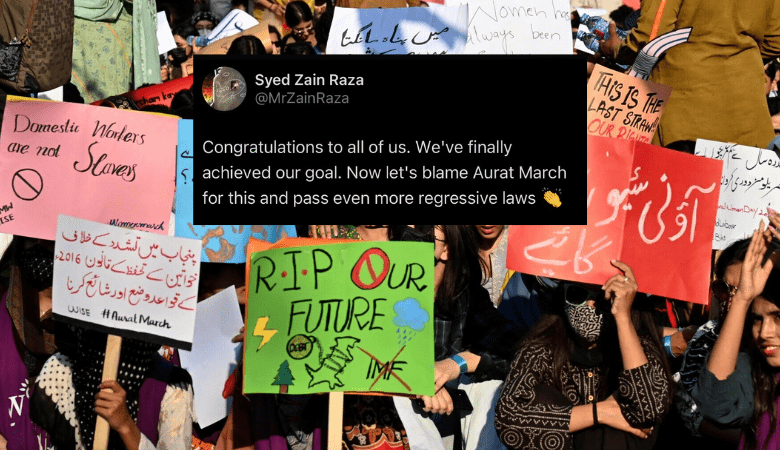
Following the revelation of Pakistan’s rock-bottom ranking, a significant portion of the public discourse turned to the persistent criticism and hate received by the Aurat March, one of the few feminist collectives actively mobilizing people and working towards reduced gender disparity in the country. “Congratulations to all of,” one X user wrote sardonically, “We’ve finally achieved our goal. Now let’s blame Aurat March for this and pass even more regressive laws.” Another user expressed similar frustration, stating that Pakistan was “officially the worst place in the world to be a woman. But hey let’s bash Aurat March and pretend everything is right.” The ironic observation by yet another user encapsulated the absurdity: “Imagine being the 148th out of 148 countries in [the] Global Gender Gap and still somehow finding problems when women speak up against gender inequality and disparities.” Unfortunately, as the article concludes, there is no need to imagine.
More than ever before, this moment calls for an intense and unwavering focus on women’s rights and empowerment in Pakistan. The damage is already done, and the country is long past the tipping point. Pakistan’s bottom ranking reflects the deeply ingrained systematic and societal inequalities that fundamentally infringe upon a woman’s basic rights. Not only does society continue to deny women equal rights, opportunities, and safety, there is a pervasive inability to tolerate when they demand what they rightfully deserve. Pakistan remains far from meaningful change when it comes to true gender equality. The onus lies not just on policymakers but collectively on society as a whole to urgently address these disparities. Without immediate, sustained, and genuine commitment, gender equality in Pakistan will tragically remain an elusive dream.