Destruction of Agricultural Biodiversity: Climate Change Has Put Pakistan’s Food at Risk
Rising temperatures, extreme floods, droughts, and pests are silently destroying Pakistan’s native crops, traditional seeds, and farming systems, threatening food security, rural livelihoods, and the future of sustainable agriculture.

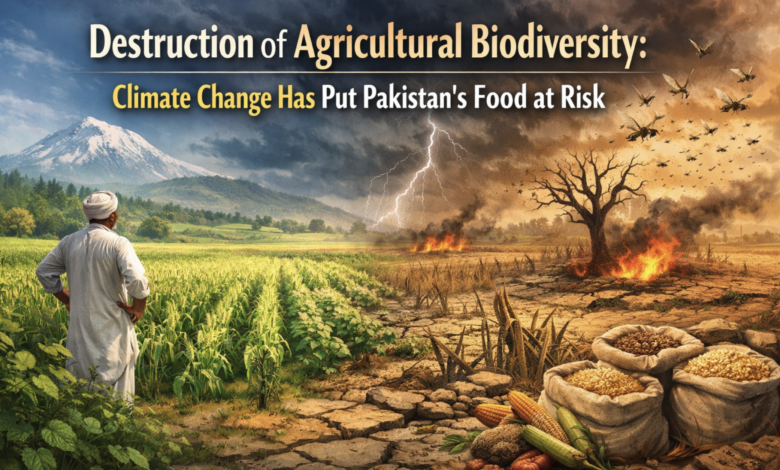
The food is not good; despite expensive spices, there is no taste in it. Even after eating, there is still hunger. The stomach is full, yet after eating, one feels like eating something more. Even after a meal, there is a strange laziness; there is no energy in the body. These are the sentences we often say ourselves or hear from others. And what is the reason for this? The reason is climate change…
Now you may say that I am trying to link everything to climate change, but it is not me saying this — experts are saying it. The effects of climate change are impacting our food.Agricultural biodiversity is being severely affected; the floods that come every year are impacting our food. Due to the negative effects on agricultural biodiversity, our food is no longer balanced, nor does it have the same nutritional value as before, nor does it contain the necessary nutrients. In other words, the food that is now reaching us, according to experts, is deficient in iron, zinc, and protein. That is why we often feel exhausted even after eating and feel unwell.
If you are still not convinced, then take a look at these statistics. Recently, GAIN released a report highlighting the devastation of agricultural biodiversity, meaning the losses in crops.According to statistics from the report of the Global Alliance for Improved Nutrition, due to climate change there is a risk of up to a 30 percent increase in hunger by 2050. By 2050, climate impacts could cause an additional 500,000 deaths annually. In Pakistan, wheat production is expected to decline by 19 percent by 2060. A significant decrease in wheat production in Punjab poses a threat to national food security. Balochistan and interior Sindh are likely to be the most affected by climate disasters.
Globally, only 2 percent of climate projects include nutrition. In Pakistan, there is an urgent need for coordination between climate and nutrition policies because extreme weather conditions have become a major threat to food, livelihoods, and health. Rising carbon dioxide levels are reducing the nutritional value of staple crops. The report also reveals that changes in temperature and rainfall have led to reduced levels of protein, zinc, and iron in crops. Due to climate change, the risk of malnutrition and stunted growth in children has increased. Threats such as floods, droughts, and glacial lake outburst floods have also intensified.The agricultural sector, livestock, forests, and water resources are at risk of being severely affected. Intense heat and drought are putting pressure on health and food systems. It has also been revealed that there are no clear nutrition-related targets or dedicated budget allocations. According to experts, there is still room for improvement in national climate policies. At this time, environmental degradation is proving costly for human health.
Regarding how agricultural biodiversity is being affected and the extent of the damage we are facing, Professor Dr. Muhammad Sanaullah from the University of Agriculture Faisalabad said that climate change is no longer just an environmental issue that is merely changing our weather and increasing temperatures. Its biggest impact is on food security. When climate change occurs, it leads to floods, heatwaves, and droughts, and all of these factors affect human health, our nutrition, our food security, and the availability of food.
He said that we now need to examine the gaps within existing policies. Dr. Muhammad Sanaullah further added that unfortunately, Pakistan is among the top countries in the world that are most affected by climate change.For us, it is more important that instead of responding only after a problem occurs, we prepare in advance so that when challenges arise, there is already a system in place to manage them and minimize losses. A large portion of our population already suffers from malnutrition, and climate change is worsening this situation. That is why we believe a nexus approach is needed — one that brings together climate change, agriculture, water experts, and policymakers to collectively design a plan through which we can solve our problems together.
Dr. Muhammad Sanaullah said that we are not practicing smart agriculture or environmentally friendly farming. In recent years, we have not properly reviewed our practices — for example, we have used excessive chemicals and disturbed natural plantations. As a result of these actions and the climate changes that have followed, when habitats change, biodiversity is also affected. Over the past ten years, there were certain plants, birds, and species that once existed and were beneficial for us, but due to our own actions, we have damaged them. As a result, they are no longer visible Continuing his discussion, Dr. Muhammad Sanaullah said that climate change has a direct impact on our biodiversity, and biodiversity conservation is one of our key goals. Until we achieve this, we cannot lead a sustainable life. Biodiversity plays a very important role in agriculture, but unfortunately, agricultural biodiversity is often neglected. This cannot be addressed individually — we must work together. A nexus approach is needed, involving researchers, policymakers, the government, stakeholders, and farmers.
Farmers need proper training and guidance on how to better survive these challenges. It is necessary to adopt climate-smart agriculture. Our agriculture contributes 50 percent to the impacts of climate change, yet our practices are not adequate. Agriculture is the sector most affected.
For farmers, this situation can be an opportunity: if they practice smart agriculture, the health of the soil will improve. By taking care of the soil and focusing on its health, resilience will increase, productivity will rise, crop yields will improve significantly, net income will grow, and it will also help mitigate the effects of climate change.
When speaking about this report, Faiz Rasool, Head of Policy and Nutrition, said that the relationships between the three key sectors need to be studied so that we know in advance where we stand and what measures we need to take before a problem arises. We need to build connections between food security, climate change, and nutrition.
Faiz Rasool continued, saying that nutrition is a major challenge for us. For a long time, our children have been suffering from malnutrition, and the figures are alarming — nearly 62 to 64 percent of Pakistanis cannot afford a balanced diet. Floods are increasing food insecurity, and millions of people are facing health problems. In Pakistan, people are experiencing three types of issues: they are not getting proper food; if food is available, it is not safe enough to keep them healthy; and third, the food they are getting does not contain the required micro-nutrients. We are eating, but the impact is not coming through. These are all complications we have been facing for some time, and now climate change has added another layer of problems.Expressing concern, Faiz Rasool said that unfortunately, there is still no local data in Pakistan that allows us to measure how much wheat production would decrease if the temperature rises by one degree. By 2029 or 2030, we might be able to have local data that can show us the impact of increasing climate change. Globally, the risk is up to four degrees Celsius, while in Pakistan, temperatures could rise up to five degrees Celsius. By 2050, where will we stand with this scenario?
Once we have this data as evidence, we will be able to use it with pride and inform policymakers and program designers. It will guide us on how to practice agriculture, which types of seeds to use, and how to move towards climate-resilient agriculture.
When I asked why there has been such a delay in collecting data, Faiz Rasool explained that work on the Food System Dashboard had started two years ago. You might be surprised to hear that in Pakistan, we only had data for 26 indicators, whereas other countries have data for more than 200 indicators. And even to collect data for these 26 indicators, it took us a year and a half of effort and engagement of consultants.
The problem is that we lack sufficient data, and what data we do have is scattered in small fragments and not consolidated. Now, the government is taking action, and the recent development is the National Food System Transmission — a digital platform at an advanced stage for data sharing, which also uses artificial intelligence to help users interact with the data, use it, and gain insights.
However, complications remain. The biggest issue is that different policies are not interconnected. If there is a food security policy, it does not address climate change. If there is a climate change policy, it does not address food security challenges. Unfortunately, Pakistan has no nutrition policy at all. The gap is so large that if you look at small countries in Africa — ten of their countries combined are equivalent in size to Pakistan — they have had national policies in place for the past fifteen years. Meanwhile, Pakistan, a much larger country with millions of children suffering from malnutrition, still lacks a nutrition policy.
We also need to consider key crops that use water. We must focus on crops that are climate-resilient and require less water because we are already a water-scarce country. We need to identify which crops and which techniques or technologies can help us use fewer resources while producing better yields that are both beneficial and valuable for us.
The Meteorological Department has also stated that temperatures will continue to rise. Deputy Director Irfan virk said that, considering the current climatic conditions, agricultural departments should focus on the best research and develop plans in accordance with climate change.
Now, if food is not balanced and nutritious, who will be most affected?
In an exclusive conversation, Country Director of the Global Alliance for Improved Nutrition, Farha Naz, explained that climate change is severely impacting our land. However, the way we farm and use excessive chemicals is damaging soil health. We have forgotten our traditional practices, such as planting diverse crops and restoring soil strength with nitrogen. Without healthy soil, where will micro-nutrition in our food come from?
She added that new seeds are now being developed to be bio-fortified, but if the soil’s health is poor, even these will not deliver proper benefits. Farha Naz expressed concern that when these chemicals transfer to women, they have broader health impacts. If food is not nutritious, mothers will not be healthy, and if mothers are not healthy, how can children be born healthy? She further stated that if children do not receive sufficient micro-nutrition, their growth is affected, along with their mental and physical health.
Agricultural biodiversity is extremely important and cannot be ignored. If agricultural biodiversity decreases, our future food options will be limited, and coping with climate shocks will become difficult. Climate change is no longer just news — it is now directly connected to the food on our plates. A red alert for our health has already been issued. However, experts say that environmentally friendly farming can help mitigate some of these problems to a certain extent.