Cholistan Canal Project Called “A Crisis of Existence” for Sindh’s Women at Karachi Baithak
Activists, civil society groups, and women leaders unite to denounce the canal project, calling it a threat to Sindh’s water, identity, and women’s survival.

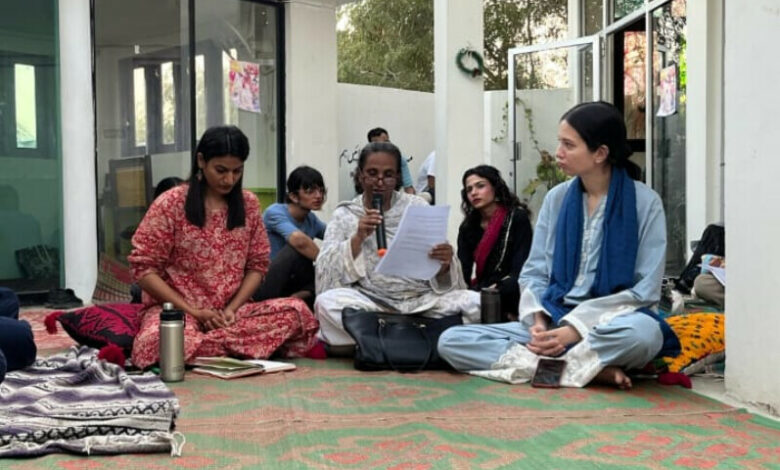
KARACHI: In an emotionally charged baithak held at Kitab Ghar, Karachi, civil society groups, activists, and community members gathered under the banner of Aurat March and the Women Democratic Front to discuss the life-threatening implications of the Cholistan canal project on the people of Sindh—especially women. The forum echoed a unified message: this is not just a development dispute; it’s a crisis of existence.
As protests against the six proposed canals under the Green Pakistan Initiative sweep across Sindh, fears are mounting that the province will lose its rightful share of water—jeopardizing both livelihoods and identity. From blocking highways to holding sit-ins, the people of Sindh are making their resistance known.
The discussion placed a sharp focus on how water, land, and gender intersect in the crisis. Panelists called the Indus River the “lifeline and identity” of Sindh, not just a natural resource. Led by Muneeba Hafeez, Finance Secretary of the Women Democratic Front, and veteran activist Mariam Gopang from Sindhyani Tehreek, the session offered sobering insights into how the canal project could deepen systemic inequalities.
Hafeez opened with a haunting poetry recitation likening the destruction of the Indus River to the tragedy of Karbala. “Sindhu jo pait pharyo wayo… Sindhu tay top charyo wayo,” she read — a powerful metaphor for exploitation and resistance.
Highlighting the unseen labor of rural women, Hafeez noted how women already juggle domestic chores, farming responsibilities, and hours-long treks for water. The proposed canals, she argued, would push their lives into even deeper hardship. “Water scarcity will not just steal livelihoods, it will steal futures,” she warned.
Gopang added emotional depth, describing how fisherwomen from Thatta, Sajawal, and the Manchar and Keenjhar lakes spend their entire lives bound to the Indus. “Taking the Indus away from Sindh’s women is like taking away their world,” she said, emphasizing how seawater intrusion — a direct result of reduced freshwater flow — is already forcing mass displacement.
The gathering also reflected on intergenerational resistance. Gopang shared a powerful memory of protesting the Kalabagh Dam with her four-month-old daughter decades ago. “Today, that same daughter is back on the streets, now carrying her infant,” she said. The fight, it seems, never ends.
Participants criticized the growing gap between urban and rural experiences, pointing out that the first casualty of any crisis is usually girls’ education. Others highlighted the silence of urban elites and the state’s indifference toward working-class women’s realities.
In a symbolic show of unity, Gopang called on attendees to transcend political differences and raise their voices wherever possible. “This is a fight for survival — block roads, protest, resist,” she urged.
Although Prime Minister Shehbaz Sharif recently announced the project would be paused, the Save Indus River Movement has dismissed it as political posturing, calling it a betrayal. The movement vows to keep fighting until the project is permanently scrapped.
For the women of Sindh, the Indus is more than a river — it’s life itself. And in their own words: “If Sindhu dies, our culture will die with it.”