

In a nation where, according to the most recent Human Development Reports, just 48.7% of women and 70% of males are literate, Pakistani women’s advancement in STEM fields—science, technology, engineering, and mathematics—is not only noteworthy, but revolutionary. This is not just a sentimental story; intricate statistics support this shift and indicate a fundamental alteration in Pakistan’s social and economic structure.
Literacy and the Surge in STEM Interest
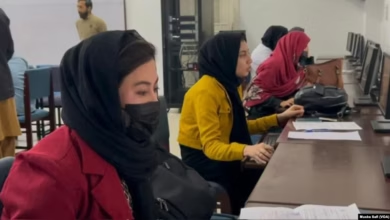
The sharp increase in female literacy and interest in STEM fields points to a substantial change in Pakistan’s socio economic landscape that may reshape gender norms. In addition, this intellectual motivation encourages women to examine opportunities that they would not have otherwise considered and to seek outside conventional career pathways.
Statistical Evidence of Change
Over the past five years, there has been a 25% increase in the number of female students enrolled in STEM fields, according to a research published by the Pakistan Institute of Engineering and Applied Sciences (PIEAS). This is an unquestionable indication that women are breaking down barriers and entering industries that have historically been dominated by men. The fact that this shift is occurring at a time when Pakistan is ranked 151st out of 153 nations in the World Economic Forum’s 2020 Global Gender Gap Report makes it even more intriguing.
Government Initiatives
The government has started a number of initiatives, maybe in response to the worldwide movement for gender parity in STEM fields. Scholarships such as the ‘National STEM School Programme’ primarily target young girls and provide financial incentives to encourage females to pursue careers in science and technology. Additionally, Pakistan’s tech accelerators and incubators, including The Nest I/O and Plan9, indicate a rise in the number of female-led businesses.
Grassroots Activities
The government’s role is important, but it’s not the only one. The impact of grassroots activities has been significant. Initiatives such as ‘Women in Tech PK’ provide a forum for seasoned women in STEM to mentor their more junior colleagues. This method has yielded practical outcomes; it is not merely theoretical. Consider Dr. Fauzia Idrees, who has received recognition on a global scale for her efforts to cybersecurity, an area that is infamously devoid of female diversity.
Economic Justification
Now let’s turn to the economic justification for this trend’s acceleration. The World Bank estimates that Pakistan’s GDP may increase by 30% if the gender participation gap were to be closed. In a country where women make up only 24% of the labour force (Labour Force Survey of Pakistan 2018-2019), it would be economically irresponsible to overlook the unrealized potential of almost 50% of the population.
Societal Implications
However, the issues here go beyond GDP figures. The ramifications for society are enormous. Think about how this might affect social norms in the long run. Only 1% of women in Pakistan work in technology, per a report conducted by the local advocacy group Circle Women. We can anticipate that the increasing number of women pursuing lucrative STEM careers will upend the established power structures in households.
Global Impact
The truth of this cultural revolution has ramifications for the entire world. As Pakistani women break through barriers in STEM, they dispel prejudices about Muslim women worldwide as well as home gender norms. By breaking these stereotypes, these women become global spokespeople for a contemporary, forward-thinking Pakistan.
Challenges and Obstacles
But it’s important to recognise the obstacles. As per a research by the Alliance Against Sexual Harassment, notwithstanding the progress made, the prevalence of sexual harassment in the workplace is still quite high, affecting 93% of women in some capacity. It is naïve to believe that this toxic atmosphere won’t affect STEM professions. Strong regulations need to be in place to safeguard these trailblazing women.
Call to Action
It is up to us to decide. Furthermore, the goal is not only individual development but also group advancement. A society is prepared to take on an infinite future when it allows its women to be trailblazers in domains such as STEM. The increase of female STEM professionals and graduates in Pakistan is more than a glimmer of hope in an otherwise dismal room; it is a light that can lead the country to new heights. However, it is our responsibility as educators, legislators, and a society to make sure that this light doesn’t go out. Rather, we ought to be the wind that fans the flames and lights up the whole scene of what it means to be a forward-thinking, modern Pakistan.
Conclusion
The increase of Pakistani women in STEM fields is not a coincidence nor insignificant. It is a deliberate revolution supported by the courageous women who dare to challenge conventional positions and driven by changes in policy and societal requirements. We are at a turning point as a nation. Either we may stand still, stifled by antiquated beliefs, or we can advance under the direction of a new breed of women who are equally adept at defying social norms and learning to code and do mathematics.