Aurat March 2025: Women in Pakistan Continue Their Fight for Rights
Pakistani women march for rights despite resistance, chanting for freedom and justice at Aurat March 2025, highlighting gender-based violence, low conviction rates, and the ongoing struggle for equality.

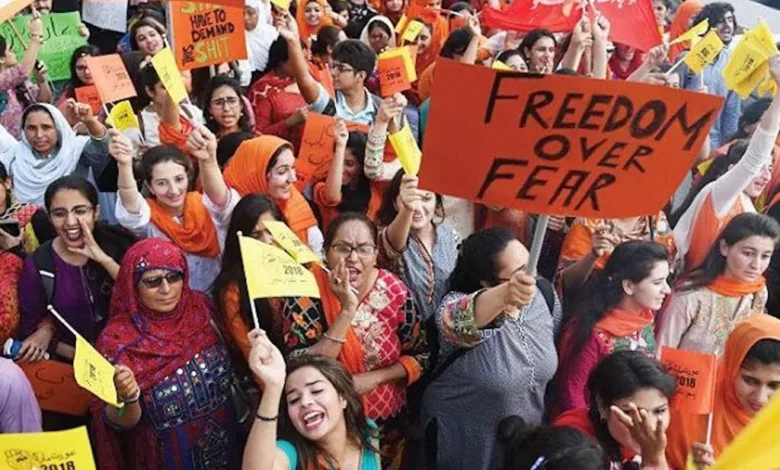
In a powerful and symbolic display, a procession of women clad in yellow vests and sunglasses carried a stretcher draped in a white shroud through the streets of Islamabad on March 8, marking International Women’s Day. Written in Urdu on the fabric was an epitaph: “Women’s Rights”, a striking representation of the struggles women continue to face in Pakistan. The march moved through a crowd of demonstrators outside Islamabad’s National Press Club, where slogans such as “My Body, My Choice” and “No to Patriarchy” were displayed on placards.
Chanting “Azadi!”—the Urdu word for freedom—the protesters made their voices heard despite facing police resistance, including the confiscation of their loudspeakers and blockades on adjacent streets.
Protests Held Under Heavy Security
For the past seven years, feminist groups across Pakistan have organized the Aurat March (Urdu for “Women’s March”) on March 8, demanding gender equality and justice. However, these demonstrations often face backlash from conservative groups, labeling them as immoral. This year was no exception. Just a hundred yards away, a group of counterprotesters, shielded by a police barrier, expressed their outrage, shouting: “We will not let these women defy our societal norms!”
For the sixth consecutive year, Islamabad’s authorities denied the Aurat March an official permit, forcing organizers to hold a sit-in instead of a procession. Despite these restrictions, activists refused to back down. Tahira Abdullah, a 71-year-old feminist icon, stood firm, wrapped in a keffiyeh, declaring:
“We will not back down! There are 400 of us here today, and we will keep fighting to our last breath!”
Her words were echoed by Punjrush, a 32-year-old actress, who passionately stated:
“This is about survival. I have no choice but to be here and demand my fundamental rights.”
Pakistan Ranks Among the Worst for Gender Equality
The Aurat March began in 2018 in Karachi, initiated by feminist collectives such as the Women Democratic Front (WDF). Since then, it has expanded to other cities, demanding concrete action on gender equality in a country that ranks second to last on the Global Gender Gap Index by the World Economic Forum.
According to Tooba Syed, a WDF member and gender researcher:
“In the 1980s, grassroots activism emerged to challenge the anti-women laws imposed by General Muhammad Zia-ul-Haq. But in the decades that followed, feminist activism was mostly confined to institutional efforts and NGO work. It wasn’t until the Aurat March in 2018 that feminist demands returned to the streets.”
A Struggle Against Patriarchy
Despite its impact, the Aurat March remains controversial in Pakistan’s deeply patriarchal society and struggles to attract mass participation. However, activists argue that the movement has raised awareness, encouraged political engagement, and pressured political parties to address gender equality.
As the crowd swelled, a theatrical performance unfolded—actors wrapped in red scarves staged a strangulation scene, depicting the horrifying reality of gender-based violence in Pakistan. A recent report by the Sustainable Social Development Organization revealed that conviction rates for rape and honor killings are nearly nonexistent—just 0.5%.
The Fight Continues
Despite facing resistance, threats, and opposition, the Aurat March 2024 reaffirmed its commitment to demanding justice, freedom, and equal rights for women in Pakistan. As activists continue their fight against patriarchy, their voices grow louder, ensuring that the struggle for women’s rights remains at the forefront of the nation’s discourse.