Widespread Condemnation After Bihar CM Nitish Kumar Pulls Woman’s Niqab in Public
Incident sparks outrage in India and Pakistan, raising urgent questions on women’s dignity, religious freedom, and political accountability.

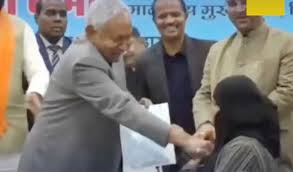
Bihar Chief Minister Nitish Kumar has come under international scrutiny after a video surfaced showing him forcibly removing a Muslim woman’s niqab during a public ceremony in Patna. The incident occurred while Kumar was presenting a certificate to Nusrat Parveen, an AYUSH doctor, and captured him pulling her niqab without consent, exposing her face in front of hundreds of attendees. The moment left Parveen visibly startled, while others on stage laughed or offered minimal intervention.
The clip quickly went viral, prompting condemnation across India and Pakistan. Social media users, activists, and politicians have demanded a formal apology and called for Kumar’s resignation, describing the act as a blatant violation of personal autonomy, religious freedom, and human dignity. The Human Rights Council of Pakistan labelled the incident “highly shameful, reprehensible, and inhumane,” urging the Indian government to launch an immediate, impartial investigation. The council emphasised that such acts are an assault on women’s rights and must be addressed with formal legal and institutional measures.
Public figures in India echoed these concerns. Former actor Zaira Wasim demanded an “unconditional apology,” highlighting that a woman’s dignity should never be treated as a prop for public display. Indian politician Priyanka Chaturvedi criticised the environment where victims are pressured to appear forgiving, while Lok Sabha member Aga Syed Ruhullah Mehdi called Kumar’s behavior “indefensible” and questioned his suitability to hold office.
Online commentary highlighted the deeper implications of the incident. Many users called it an “abuse of power” and a violation of personal choice, drawing parallels to forcibly removing other religious or cultural attire as a clear breach of respect. Social media discussions also drew attention to the casual manner in which the incident unfolded — on a formal stage, under state sponsorship, and with laughter in the background — illustrating normalized Islamophobia and gendered harassment in public spaces.
The context underscores the significance of consent and autonomy. Covering one’s face with a niqab is a personal choice rooted in religious, cultural, or personal reasons. Removing it forcibly, particularly in a public setting by a male authority figure, constitutes humiliation and harassment. The event has sparked renewed discussions about respecting women’s bodily autonomy and maintaining professional decorum, especially for public officials.
Observers noted the irony that while some modern films continue to villainize Muslims, real-life political leaders are demonstrating similar acts of disrespect. Past cinema, such as My Name Is Khan, has depicted forcibly removing a Muslim woman’s hijab as a symbol of post-9/11 Islamophobia, highlighting the emotional and social trauma it represents. Kumar’s actions, occurring in an official capacity, underscore the gravity of undermining a woman’s right to choose her appearance.
The incident has intensified debates about accountability, societal norms, and the treatment of women and religious minorities. While some argue that veiling can be influenced by family or societal pressure, no circumstance grants anyone — particularly those in positions of political authority — the right to violate a woman’s bodily autonomy. Consent, not convenience or curiosity, remains the only acceptable standard, and public leaders are expected to uphold it.
The episode serves as a stark reminder of the ongoing need to protect women’s rights, religious freedom, and dignity, emphasizing that violations under state authority are unacceptable in any society that claims to value equality and justice.