Mogadishu Rises: Women Engineers Lead City’s Reconstruction Amidst Boom and Challenges
Fathi Mohamed Abdi and Saadia Ahmed Omar, two young female engineers, defy traditional norms to oversee major construction projects, symbolizing Mogadishu's dramatic rebirth from its violent past.

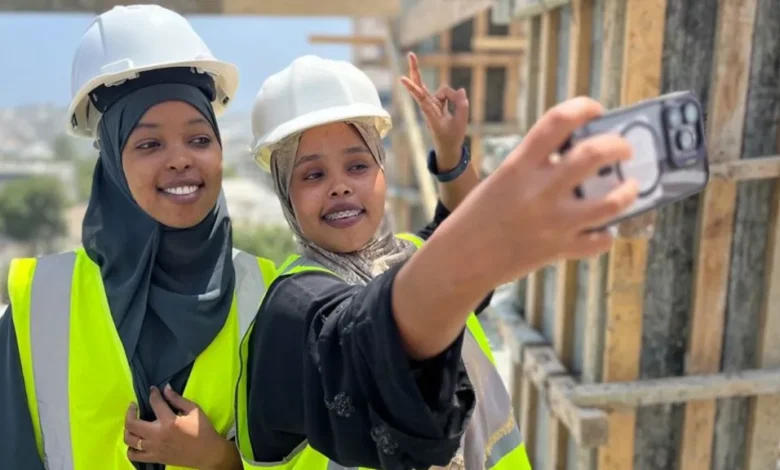
LONDON – Somalia’s capital, Mogadishu, is experiencing an unprecedented construction boom, quite literally rising from the ashes of its violent past. This rapid urban transformation is not only reshaping the city’s skyline but also creating unexpected opportunities for women, exemplified by the pioneering work of Fathi Mohamed Abdi and Saadia Ahmed Omar. These two young female engineers are at the forefront of this resurgence, overseeing the construction of a 10-floor apartment complex in the city’s Hodan District, specifically in Taleh.
Clad in their hard hats, Ms. Abdi and Ms. Omar navigate bustling construction sites, confidently issuing instructions to teams composed entirely of men. Their presence is a powerful statement in a society traditionally dominated by men, challenging ingrained perceptions. “When I started, people doubted me,” shares 24-year-old Ms. Abdi, who serves as the chief operating officer of Arkan Engineering Services, a Somali-owned construction company. She recounts the initial skepticism: “They would ask, ‘How can we trust a house built by a woman? How can I trust my money and property with a young female engineer?'” Despite these initial challenges, both Ms. Abdi and her colleague, Ms. Omar, also 24, have been actively practicing as engineers for the past five years, accumulating invaluable experience. “Mogadishu needs us,” asserts Ms. Omar. “When I was young, this city was in chaos. Now, we are part of its reconstruction.”
Somalia, a former Italian colony, endured a prolonged period of civil war following the collapse of President Siad Barre’s government in January 1991. Even today, the scars of decades of conflict remain visible in districts like Shangani, where bombed-out buildings stand as stark reminders. However, these ruins are steadily being hidden or replaced by towering new office complexes and apartments, creating a skyline now dotted with cranes and scaffolding. Both young women were born during this tumultuous civil war and grew up witnessing their country’s fragmentation. While many Somalis sought refuge abroad, they chose to remain, driven by an unwavering passion to rebuild, even as the al-Qaeda-linked al-Shabab insurgency continued its destructive campaign. Ms. Omar believes that the sheer volume of work and a shortage of skilled professionals in the field have inadvertently created space for women to thrive. “I think part of the reason women are getting more chances in this field is because there’s so much work to do, and not enough professionals to do it. That creates space for us,” she states.
Ibrahim Abdi Heyle, the 34-year-old chairman of the Somali Engineers Association, concurs with Ms. Omar’s assessment. He acknowledges that the high demand for skilled professionals is indeed instigating change, albeit slowly, within Somalia’s traditionally male-dominated society. “With numerous ongoing infrastructure, energy, and technology projects, the workload has significantly increased. As a result, the association actively encourages greater participation from women, emphasising that they are not only welcomed but also vital in filling critical gaps in the workforce,” he explains. Heyle further adds that “the association believes that empowering women in engineering not only helps meet the growing demand but also brings diverse perspectives and innovative solutions to the industry.” According to the office of the mayor of Mogadishu, over the last five years, more than 6,000 buildings have been constructed, marking a profound transformation in the city’s physical landscape. Salah Hassan Omar, the mayor’s spokesperson, attributes this surge to improved security in the capital, leading to a rise in high-rise and commercial developments.
Despite this progress, the path for Ms. Abdi and Ms. Omar has been challenging. Women constitute only 5% of engineers in Somalia, and opportunities for mentorship are scarce. “When I applied for internships, most companies rejected me,” Ms. Omar recalls. “They didn’t think a woman could handle the physical demands of engineering. I searched for three months before someone finally gave me a chance.” Today, having graduated from Plasma University Mogadishu’s faculty of civil engineering, the two are recognized as among the most prominent female engineers in Mogadishu, having successfully overseen more than 30 multimillion-dollar projects. Ms. Abdi proudly notes, “The city is now home to taller buildings and modern infrastructure, a stark contrast to the Mogadishu of the past.”
However, not everyone embraces this rapid transformation. Veteran architect Siidow Cabdulle Boolaay laments the potential loss of the city’s historical character. “The buildings that once graced Somalia before the war were not only beautiful but also attracted attention due to their Italian-style architecture, which was rare in Africa at that time,” he tells the BBC. He also expresses concern over safety issues, particularly regarding the use of salty sand from Somalia’s long coastline in construction, a practice generally discouraged by international building standards due to its corrosive effect on steel. Mr. Boolaay also worries that many of these new tall buildings are not designed to withstand fire or heavy rain and lack essential safety features like fire extinguishers and proper electrical installations, visibly expressing his disappointment at the compromise on quality control driven by the rapid pace of construction.
Mr. Omar, from the mayor’s office, concedes that there were no regulations in place until three years ago and that nothing can be done about the buildings constructed during that period. However, he insists that “quality control and nobody will build a building without it” is now in effect. He also mentions the preparation of “new laws that will clearly define where high-rise buildings can be constructed and where only residential houses should be built.” Nevertheless, concerns persist that even with regulations in place, follow-up checks are often insufficient due to the sheer speed of the building boom. Despite these challenges, Ms. Abdi and Ms. Omar confirm that all projects under their firm have received local authority approval.
The accelerated growth in construction projects is largely attributed to significant diaspora investments and an improved security situation, even though Islamist militants continue to target the city. Remittances constituted a substantial 16.7% of Somalia’s gross domestic product (GDP) in 2022, according to the World Bank, providing significant opportunities for architects and engineers. However, this rapid urbanization has also exposed Mogadishu to critical infrastructure challenges, including a lack of proper sewage systems and the risk of depleting groundwater reserves due to unregulated borehole drilling. Christophe Hodder, a UN climate security and environmental adviser, warns that this unchecked construction boom could lead to severe long-term environmental consequences. “We need a co-ordinated approach to water management, or we risk a crisis in the future. Each new building is digging its own borehole… in a small space, there could be 10 or 20 boreholes,” he cautions. While the government, in partnership with international organizations, is working on a new sewage system, its implementation may necessitate demolishing existing buildings, a controversial move that could displace residents and businesses. Hodder also highlights the high population density in Mogadishu, driven by people fleeing drought and conflict, which could exacerbate poverty and social disparities, particularly in slum areas.
Despite these underlying challenges and the continued threat of bombings by al-Shabab, the enthusiasm of the Somali Engineers Association remains undimmed. Mr. Heyle acknowledges the upset caused when engineers’ and architects’ buildings are destroyed but stresses the resilience of Somalis, especially those pursuing engineering. “A lot of explosions happened; our dreams did not stop on that. Today we are reviving the engineering profession, which collapsed 30 years ago. That means there is hope.” The overarching ambition is that within five years, Mogadishu will transform into not only a modern city but also a global model for post-conflict reconstruction. Ms. Omar articulates this vision: “I believe Mogadishu is a different city compared to the 1990s; the city has changed to a new style, and Mogadishu’s development is in line with the new world. When I walk through the streets and see buildings I helped construct, I feel proud. We are not just building structures; we are building hope.” Ms. Abdi echoes this sentiment, adding, “We are proving that women can not only design buildings but also lead projects and shape the city.” Their work is a powerful testament to the city’s enduring spirit and the transformative power of female leadership in rebuilding a nation.