Young South Korean Women Fight to Be Heard Amid Political Silence
After leading mass protests against former president Yoon's martial law and anti-feminist stance, young women feel ignored as major candidates sideline gender equality in the upcoming election.

An Byunghui was deeply immersed in a video game on the night of December 3rd when she suddenly learned that the South Korean president had declared martial law. At first, she found it hard to believe. But soon the internet was flooded with undeniable proof — the shocking announcement by then-President Yoon Suk Yeol, accompanied by widely shared images and videos showing soldiers breaking the windows of the National Assembly, and members of parliament climbing walls to storm the building in order to block the martial law vote.
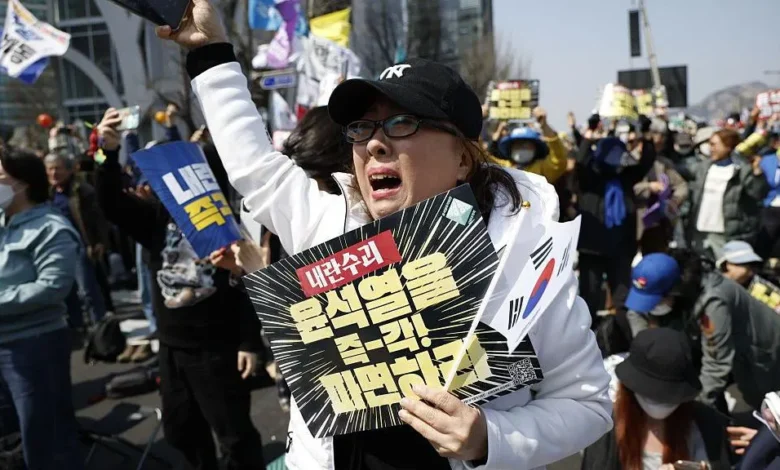
Within just a few hours, thousands of people had taken to the streets in protest, especially young women. Byunghui was among them, making the long journey from her hometown of Daegu in the southeast all the way to the capital, Seoul. These women didn’t gather only because Yoon’s martial law declaration shocked and enraged them, but also because they wanted to stand against a president who repeatedly claimed South Korea was free of sexism—despite the widespread discrimination and incidents of violence against women that proved otherwise.
Week after week, these women kept returning to the protests as the investigation into Yoon’s abuse of power unfolded. They celebrated when he was finally impeached after a tense four-month period. However, with a new presidential election approaching on June 3rd, many of these young women feel once again ignored and marginalized.
The two leading candidates have remained largely silent on issues of gender equality, a subject that has become deeply divisive in South Korea. This topic had actually helped Yoon rise to power in 2022, as he positioned himself as a defender of men who felt sidelined by what they perceived as an overly feminist society. Meanwhile, a third candidate, who has gained popularity among young men for his openly anti-feminist stance, has been grabbing headlines.
For many young South Korean women, this emerging candidate represents the beginning of a new struggle. “So many of us felt like we were trying to create a better world by attending the anti-Yoon rallies,” says the 24-year-old college student. “But now, I wonder if anything has truly changed… I can’t shake the feeling that they’re trying to silence women’s voices.”
When Byunghui first arrived at the protests, she was struck by the powerful energy surrounding her. Despite the bitter cold of December, tens of thousands of women gathered, bundled in hooded jackets or huddled beneath umbrellas, holding light sticks and banners, singing hopeful K-pop songs as they demanded Yoon’s removal from office.
“Most of the people around me were young women,” she recalls. “We were singing ‘Into the World’ by Girls’ Generation.” This 2007 hit from one of K-pop’s most iconic groups became something of an anthem during the anti-Yoon protests. Notably, the same song had been sung by women almost a decade earlier during anti-corruption demonstrations that led to the downfall of another president.
“The lyrics — about never giving up on this world and dreaming of a new one — they just overwhelmed me. I felt connected to everyone around me,” Byunghui says.
While official numbers aren’t available, local research by the Chosun Daily estimates that about one in three protesters were in their 20s or 30s. BBC Korean’s analysis of a December rally, which drew 200,000 people, found that women in their 20s formed the largest group—about 18% of attendees—compared to just over 3% men of the same age.
These protests energized young women in a country long plagued by discrimination, sexual harassment, and violence against women. South Korea also has the widest gender pay gap among wealthy nations, at 31%. Like many countries facing plunging birth rates, South Korean women face mounting pressure to marry and have children, often encouraged by politicians to conform to traditional patriarchal roles.
“I felt like all the frustration I’d held inside finally exploded,” says 23-year-old Kim Saeyeon. “I think that’s why so many young women showed up. They needed to express their dissatisfaction.”
For 26-year-old Lee Jinha, the drive to see Yoon removed was a powerful motivator: “I tried to attend every week. It wasn’t easy — it was freezing, incredibly crowded, and my legs hurt, plus I had a lot of work. But I felt a real sense of responsibility.”
This response makes sense, says Go Min-hee, an associate professor of political science at Ewha Women’s University. She explains Yoon was known for his “anti-feminist” stance and made it clear he would not support policies benefiting young women.
The protests weren’t one-sided. There were also demonstrations supporting Yoon and his martial law order, largely backed by young men who viewed Yoon as their champion. Many young men believe they suffer from “reverse discrimination” — that policies favoring women put them at a disadvantage. They often cite the mandatory 18-month military service for men, which they argue unfairly sets them back compared to women.
They label feminists as “man haters,” and have been central to a fierce online backlash against gender equality movements. These groups, once largely hidden, gained mainstream traction online, especially during Yoon’s presidency.
Yoon’s campaign had deliberately targeted these young men, promising to abolish the Ministry of Gender Equality and Family, claiming it was too focused on women’s rights. Throughout his term, many government agencies with “women” in their names disappeared or rebranded to remove the reference.
This polarized the nation. Many young women saw these moves as erasing their rights, while anti-feminist backlash grew stronger. Byunghui witnessed this firsthand in Daegu, where anti-Yoon protests were overwhelmingly female. The few men present were usually older.
Young men, including high school students, would sometimes drive by the protests shouting insults and threats. “I wondered if they would behave like this if young men were leading the protest,” she says.
With Yoon removed, his People Power Party (PPP) is struggling. For the first time in 18 years, there is no woman among the six presidential candidates. “It’s shocking,” says Jinha. “There isn’t a single female candidate.” The previous election had two women among fourteen candidates.
PPP’s Kim Moon-soo is trailing the frontrunner Lee Jae-myung of the Democratic Party (DP). But many young women express disappointment with Lee, who is 61. “It was only after criticism that the DP started adding a few policies for women,” Saeyeon says. “I wish they had a real plan to fix structural discrimination.”
When asked about gender equality policies early in his campaign, Lee replied, “Why do you keep dividing men and women? We are all Koreans.” After criticism, the DP acknowledged ongoing structural discrimination against women and promised more resources to tackle inequality at every level.
In the 2022 election, Lee was more vocal about women’s issues, seeking votes after sexual harassment scandals within his party. He pledged to place women in top government positions and appointed a woman as co-chair of the DP’s emergency committee.
However, experts like Ms. Kim feel the DP is now focusing much less on young women than before. Professor Go suggests this shift is because Lee barely lost in 2022 and is now trying to appeal to the widest possible voter base, seeing feminist issues as potentially alienating.
This leaves young women like Saeyeon feeling abandoned after their active role in protests calling for Yoon’s impeachment. “Our voices don’t seem to be reflected at all in the campaign pledges,” she says.
Kim Moon-soo emphasizes raising birth rates by offering more financial support to parents, but many women say this misses the point. Rising costs aren’t the only challenge; deeper inequalities make balancing career and family nearly impossible, leading many women to reconsider traditional paths.
The Ministry of Gender Equality and Family, which Yoon tried to abolish, remains contentious. Lee promises to strengthen it, while Kim proposes replacing it with a Ministry of Future Youth and Family, focusing more broadly on families and youth.
Though the ministry’s budget for women’s equality is small—less than 7% of its funds, about 0.2% of the government budget—it is highly symbolic. Professor Go warns that abolishing it would signal that gender equality is unimportant.
Meanwhile, the third candidate, 40-year-old Lee Jun-seok, a former leader of Yoon’s party who formed the Reform Party, has attracted young men with his anti-feminist views. Though trailing Kim in polls, he has gained headlines for controversial remarks.
Recently, in a presidential debate, Lee made a shocking comment questioning whether a statement about violence against women constituted misogyny, referring to allegations involving the frontrunner Lee Jae-myung’s son. The Lee camp avoided directly addressing these claims but apologized for other offensive posts.
Byunghui says watching Lee make those remarks live on TV was “genuinely terrifying,” fearing it could embolden online incel communities. Saeyeon describes feeling “anger and despair,” and says her already low hopes for politics have sunk even further.
She believes Lee Jun-seok’s popularity among some young men reflects the consequences of South Korea’s long neglect of structural discrimination against women — a neglect that has left many women feeling invisible and unheard as the nation’s political landscape shifts.