What is the Grave Reality of Violence Against Women in Pakistan
The Persistence of Gender-Based Violence: A Global and Local Crisis


Every year, the world marks the 16 Days of Activism against violence toward women. Yet, a critical question lingers: Are we making real progress toward ending gender-based violence, or are these efforts mere symbolic gestures? The grim reality, particularly in Pakistan, suggests the latter, as violence against women remains deeply entrenched.
Shocking Statistics: Violence Against Women in Pakistan
According to UN Women, a woman is killed every 11 minutes globally. Pakistan’s situation is even grimmer, where practices like karo-kari (honour killing) persist. The Aurat Foundation’s 2020 report recorded over 11,000 cases of violence against women, including domestic abuse, rape, and murder. However, these figures only scratch the surface, as countless cases remain unreported due to societal stigma.
The Tragedy of Afshan Jamali: A Heartbreaking Reality
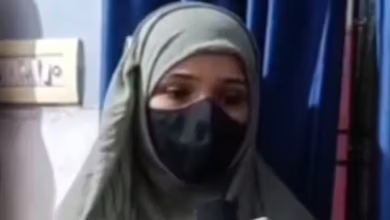
The brutal murder of Afshan Jamali, an educated school teacher in Karachi, underscores the pervasive nature of violence against women. Her death, driven by dowry demands, reveals the systemic devaluation of women, regardless of their education or achievements.
Root Causes of Violence Against Women
Patriarchal Norms and Cultural Misinterpretations
Deeply entrenched patriarchal attitudes in Pakistan reduce women to subservient roles, limiting autonomy and fostering inequality. These cultural norms perpetuate harmful power dynamics, legitimizing violence.
Misuse of Religion
Religious doctrines are often misinterpreted to justify inequities. Pre-Islamic cultural practices have merged with religious misapplications, enabling continued oppression and marginalization of women.
Economic Dependence
Economic vulnerability further entrenches gender inequality. With only 22% of women participating in the workforce compared to 84.79% of men in 2022, financial dependence leaves many women unable to escape abusive relationships.
Legal and Social Barriers to Justice
Weak Enforcement of Laws
Despite protective laws, their enforcement remains poor. Perpetrators exploit legal loopholes to evade justice, while survivors often face societal stigma and a lack of support.
Victim-Blaming Culture
A pervasive culture of victim-blaming discourages women from reporting abuse, leaving them without recourse and enabling cycles of violence to continue.
The Way Forward: A Call to Action
Strengthening Legal Protections
The legal system must be overhauled to ensure strict enforcement of laws protecting women. Law enforcement and judicial systems require specialized training to handle gender-based violence cases sensitively and efficiently.
Transforming Cultural Attitudes
Patriarchal norms must be dismantled through widespread public education on gender equality and women’s rights. Media outlets can play a pivotal role in highlighting success stories and challenging harmful stereotypes.
The Fight for Equality: A Collective Responsibility
The systemic gender-based violence in Pakistan is a fight for the nation’s soul. As the saying goes, “When women rise, we all rise.” The time for action is now, to ensure a future where no woman lives in fear or oppression. Pakistan must unite in its commitment to justice, equality, and the fundamental dignity of all citizens.