Women in Media: Guardians of Truth and Global Justice
Zeinab Asgharian emphasizes women's pivotal role in media, resistance, and exposing global injustice amid humanitarian crises

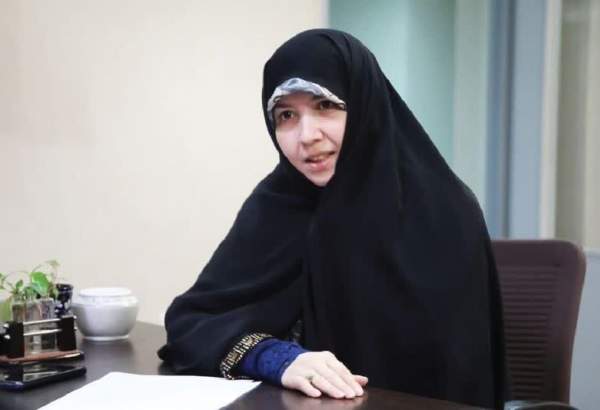
Zeinab Asgharian, university professor and international relations expert, delivered a powerful speech during the webinar titled “Media: An Effective Tool for Unity and Resistance,” which focused on the role of women in confronting the crimes committed by Israel and the United States. She called on female journalists and activists across the globe to recognize their unique responsibility in the fight for justice, stressing that in today’s world marked by escalating humanitarian disasters, the presence of women in media is more essential than ever.
Asgharian emphasized that in the face of repeated violations of international law—especially in occupied Palestine and in the Islamic Republic of Iran—women’s engagement in documenting the truth is vital. She argued that the global order, supposedly based on justice, has collapsed under the weight of military imperialism and apartheid structures, propped up by certain global powers. This collapse is reflected not only in the unending siege and bombardment of Palestine but also in aggressive acts such as the recent attacks on Iranian territory.
Referencing international law, Asgharian cited the four core crimes defined under international frameworks—genocide, war crimes, crimes against humanity, and the crime of aggression—and declared that these crimes have been systematically committed in Palestine and Iran by the Zionist regime with the open support of the United States. She called this a blatant failure of international institutions that are supposed to uphold peace, law, and sovereignty.
Asgharian stressed that women in media must not only act as reporters or documentarians but as active agents of resistance. She highlighted their responsibilities which include accurate documentation of atrocities, amplifying the voices of victims, resisting colonial narratives promoted by mainstream media, forming global solidarity networks among women, and awakening public awareness to challenge oppression at every level.
She drew particular attention to the Fordow nuclear facility, which has always operated under the full supervision of the International Atomic Energy Agency (IAEA). Any attack on this facility, she stated, is a violation of international treaties and a direct threat to regional security. Despite IAEA’s confirmation of Fordow’s peaceful use, the United States targeted it, exposing Washington’s disregard for international norms and its preference for coercive power.
Referring to international law, specifically Article 16 of the Draft Articles on Responsibility of States for Internationally Wrongful Acts, Asgharian explained that a state aiding another in committing wrongful acts is equally responsible. By this standard, she argued, the United States shares accountability for the crimes perpetrated by the Zionist regime due to its military, logistical, and diplomatic support in the war against Palestinians and in direct aggression towards Iran.
She concluded that the role of women—journalists, analysts, activists—is not only crucial in challenging power structures but also in offering a more humane, just, and inclusive narrative. Women must rise above borders and identities to lead in the global resistance against structural injustice. Their tools—cameras, pens, voices—carry the truth, and with that truth comes the power to challenge, expose, and seek justice.
Asgharian closed her remarks by warning that silence in the face of such crimes is a form of complicity. It is women in media and activism who must ensure that the truth is never buried. The webinar, organized by Iran’s World Forum for Proximity of Islamic Schools of Thought, brought together women thinkers, journalists, and civil society leaders from around the world to address these critical global issues and reaffirm the importance of unity, truth, and resistance.