VSisters: Pakistan’s First All-Women Ride Service
Offering safety, dignity, and empowerment, VSisters is transforming transport by ensuring women can travel freely without fear of harassment.

On Pakistan’s busy roads, a quiet revolution is unfolding, led by VSisters — the country’s first all-women ride-hailing service. This initiative is not just about transportation; it is about freedom, dignity, and the assurance of zero harassment. With both riders and passengers being women, every journey carries a message: Pakistani women deserve the right to move safely, confidently, and without fear.
The driving force behind VSisters is Hassan Tariq, an educated professional from Peshawar with a master’s degree from the United Kingdom. After beginning his career at HBL Karachi, he stepped into entrepreneurship not for profit, but for a purpose. His vision was rooted in a painful personal experience that left a lasting mark.
One year ago, while stopped at a traffic light in Islamabad, Hassan witnessed a young woman being openly harassed by the male rider of her rented bike. She struck him with her handbag in desperation, but before anyone could help, he sped away. For Hassan, the scene was unbearable. “My ghairat burned,” he recalled. “How can we call ourselves a civilized Muslim society when our women cannot even travel safely? That day, I vowed to create a service where no woman would have to feel that helpless again.”
After months of preparation and meeting legal requirements, VSisters officially launched on June 16, 2025. Today, it operates in Islamabad, Rawalpindi, and Lahore with 464 active female riders — 64 in Islamabad, 44 in Rawalpindi, and 356 in Lahore. Expansion plans for Karachi, Faisalabad, and Gujranwala are already in motion, signaling growing demand and trust.
Beyond transport, VSisters is also about empowerment. The company provides free motorbike training for women aged 18 and above, enabling them to earn an income while gaining independence. As Mr. Tariq explained, “Our aim is to make women not just passengers, but drivers of change.”
Success stories are already proving the model works. In Lahore, Faryal has become one of VSisters’ highest earners, bringing in an income that surpasses most jobs available to women in similar sectors. Riders earn nearly twice as much as their counterparts in male-dominated services, thanks to fair pay, high demand, and the trust built among female commuters. For many, this is more than work; it is dignity, financial stability, and a path to self-reliance.
For others, the change is deeply personal. Nimra from Rawalpindi shared, “Before VSisters, I wanted to work but safety was always a concern. Now I earn well, and every passenger tells me they feel safe with me. It’s empowering for both of us.” Passengers echo the sentiment. Ayesha, a university student in Islamabad, expressed her relief: “I travel without anxiety now. There’s no inappropriate behavior, no fear. I reach home safely, every time.”
Women’s rights activists have also praised the initiative, saying that such services are essential for reclaiming public spaces for women. “Zero harassment isn’t a luxury — it’s a right,” said Sara Khan, a Lahore-based activist. “VSisters is proving that safety and empowerment can go hand in hand.”
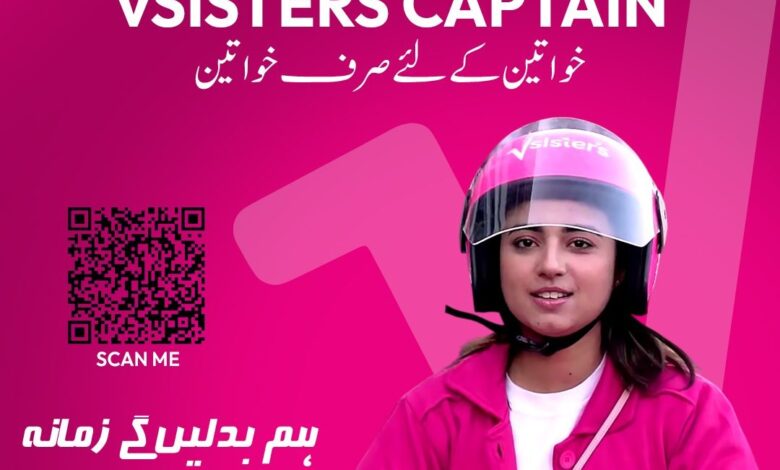
With every pink-helmeted rider, VSisters is rewriting the narrative of women’s mobility in Pakistan. Each ride is more than a commute — it is a symbol of progress, a promise of dignity, and a powerful reminder that women have the right to move freely, fearlessly, and with pride.