The Struggle for Gender Equality in Pakistan’s Political Landscape
Despite women’s significant presence in Pakistan’s population, their representation in political leadership remains limited. Comprehensive reforms are necessary to ensure genuine gender equality in politics.

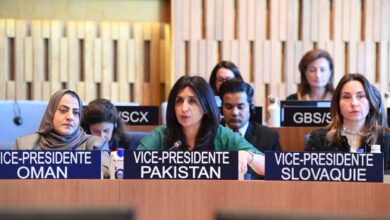
Despite comprising about half of Pakistan’s populace, women’s cooperation in political administration remains moo. Whereas sexual orientation correspondence in legislative issues could be a worldwide goal, in Pakistan, women’s political inclusion has remained negligible, with their interest in forming political talk and arrangement plans still limited.
Pakistan’s structure guarantees Gender orientation correspondence, with Articles 25 and 34 advertising protected guarantees. However, ladies involve as it were 53 seats within the National Gathering, which incorporates 12 common seats and 41 saved seats. This speaks to fair 15.5% of the 336-member get together, with only 3.5% of common seats secured through open competition.
Although administrative endeavors just like the Political Parties Arrange (PPO) 2002 and the Decisions Act 2017 point to address this sex awkwardness, they have not accomplished their expecting affect. Political parties are required to distribute seats to ladies, but numerous ladies have as it were secured saved seats, clearing out them with restricted impact in forming arrangements and motivation. Moreover, women’s underrepresentation in administration parts remains a challenge. For occasion, political parties frequently avoid the soul of the laws by constraining women’s association in decision-making.
The Races Act 2017 assist endeavored to address these issues by commanding a 5% quantity for ladies candidates in common races and pronouncing decisions invalid on the off chance that women’s voter turnout is less than 10%. However, execution remains troublesome due to constrained assets and social obstructions, especially in preservationist districts where political parties may furtively dishearten women’s interest in voting.
The circumstance is distant from uniform over Pakistan’s major political parties. PML-N, traditionally preservationist, has advanced with pioneers like Maryam Nawaz taking on unmistakable parts. The PPP contains a long history of supporting ladies, with figures like Benazir Bhutto rising as the primary female prime serve. Be that as it may, parties like PTI and JUI-F proceed to battle with significant sexual orientation representation. In spite of cutting edge slants, PTI has as it were one female part in its 33-member center committee, and social contemplations still intensely impact JUI-F’s stance.
Evidence appears that when ladies pick up political control, they prioritize arrangements that advantage society as a entire, such as healthcare, instruction, and social welfare. Ladies administrators have moreover pushed for crucial changes, counting legacy rights, labor laws, and enactment against gender-based viciousness, highlighting the benefits of gender-inclusive governance.
To make advance, Pakistan needs a systemic upgrade of its political structures. To begin with, the Political Parties Arrange and Decisions Act must be corrected to guarantee a significant increment in women’s administration positions. Moment, political parties ought to execute mentorship programs, sex reviews, and coordinated women’s wings into their decision-making forms. Third, social changes must be advanced through media campaigns and grassroots instruction to challenge obsolete sees on ladies leaders.
The Economical Advancement Approach Organized (SDPI) has effectively worked on this issue through its activity ‘Raising Her Voice in Political Parties for Causing Legislative issues in Pakistan.’ SDPI collaborates with political parties, the Race Commission, and ladies parliamentarians to drive authoritative alter and overcome boundaries to female political participation.
At the current pace, accomplishing sexual orientation equality at the national level will stay a far off objective unless considerable changes are sanctioned. It’s basic to guarantee women’s viewpoints and abilities are coordinatesinto political authority, particularly in tending to complex worldwide challenges like climate alter and financial imbalance. The address is no longer whether women have a place in legislative issues but whether our political frameworks will advance to reflect differences and rise to representation.
To honor the legacies of pioneers like Fatima Jinnah and Benazir Bhutto, systemic alter is basic for Pakistan to genuinely live up to its majority rule ideals.