Pakistan is under threat from not just one but nine types of floods, with fears of a late monsoon as well…What will the future hold??
Pakistan faces threats from nine types of floods along with fears of a late monsoon. In 2025, the future depends on urgent climate adaptation, stronger infrastructure, and disaster management to protect lives, agriculture, and the economy from worsening climate challenges.

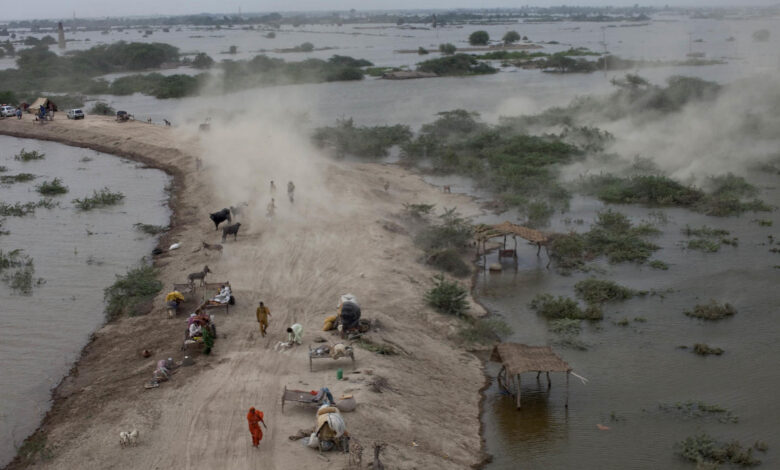
Yes, the intensity of the rains during the recent monsoon and the resulting flooding situation are directly linked to climate change. The current monsoon, which formally began a week earlier at the end of June, had already been warned about by NDMA and the Meteorological Department that rainfall would be above normal. In July and August, different areas experienced extremely heavy downpours and torrential rains, which created flooding conditions. And then, not only Pakistan but also neighboring India faced intense rains that increased river flows. India released water multiple times and subsequently sent flood-related alerts to Pakistan.A grave situation has developed in Pakistan’s rivers, especially in Punjab’s three rivers — Ravi, Sutlej, and Chenab — where high-level flooding was recorded simultaneously. This situation emerged on August 26 and is still ongoing.
In an exclusive conversation, NDMA’s climate expert Dr. Tayyab stated that such a situation previously occurred in the Ravi in 1988, in the Chenab in 2014, and in the Sutlej in 1988 and 2023. Not only this, but in neighboring Indian regions as well, records of 40 years and even 70 years were broken. Floods like this have occurred in the past too, but the current flooding situation is different.
But why is this so? What is the reason for this situation??
Regarding this, Dr. Tayyab explained that in the monsoon of 2025, two such patterns are being formed, which we call the simultaneous activation of horizontal and vertical flow. Horizontal flow means that when glaciers melt, the snow melting accelerates the flow of water in river channels. But if at the same time vertical flow, that is, the intensity of rainfall, also increases, then if both get activated together, it points towards a very large-scale flood situation.
But the alarming thing is that in the coming years, the frequency of disasters or destructions caused by climate change in Pakistan will increase, and now we are facing not just one but nine different types of flood situations. These include flash flooding, urban flooding, local inundation floods, which means floods occurring on a local or limited scale, local inundation floods that occur when rainwater accumulates in a specific area, riverine flooding which is also called river flooding, coastal storm surge flooding or simply coastal storm floods, sea water inundation flooding which in simple words means sea water floods, all of which are threats.
Continuing the discussion, Dr. Tayyab said that unfortunately, Pakistan is located in a region where, due to climate change, it faces many types of floods not only in the monsoon but also in the late monsoon or early monsoon. Dr. Tayyab also said that now we are not only talking about river floods; a new concept has started which we call a cloudburst, which in a second brings flash flooding and submerges the same place.
The climate expert expressed concern that in the coming days we will see this situation in Buner, Bajaur, and Malakand, and God forbid, we may also see it in Islamabad, because it is related to rising temperatures. Along with cloudbursts, there are torrential rains, meaning very heavy downpours. Then with cloudbursts there is a new term nowadays, “passing shower,” which means when two winds collide, a sudden strong shower occurs and within just a few seconds a very heavy rainfall takes place.
The monsoon has not ended yet. In September, there will be 3 to 4 more spells, so can the flood situation become more serious? Or can the risks of monsoon and climate change become more severe??
Climate expert Dr. Tayyab explained that it is expected that there could also be a late monsoon, meaning the monsoon may last longer than its scheduled period. According to different climate models, there will be rains in September as well. The intensity of September will remain in the first 10 days compared to the past two months, but gradually the monsoon will weaken. According to data from various models, until 15th September there will be strong flooding in our river routes, the river flow will remain fast, and our rising temperature will not only prolong our monsoon but will also increase its intensity.
Not only this, different models also show that in the coming years it is predicted that our eastern rivers, especially the Ravi, will no longer appear dry. There will be water inflow in our Punjab province because in the coming years India’s hydraulic structure will also come under stress, due to which India’s controlled releases will be reduced — meaning because of pressure on its hydraulic infrastructure, India will have to reduce its water discharge.
Maharashtra, which is India’s central region, currently has a low-pressure system that is continuously moving toward Gujarat, and adjacent to Gujarat is our Tharparkar. Dr. Tayyab explained that our data shows that Tharparkar, Tando Allahyar, Thatta, Sujawal, Badin, Tando Muhammad Khan, Mirpurkhas, as well as Ghotki and Shikarpur regions — some districts located on the eastern belt — are expected to receive rains from 6th September to 9th September, while some models indicate rains in these districts until 10th September.
In some areas of Tharparkar, hailstorms have also been forecast, and in some places, along with thundercloud formation, there is also a risk of lightning strikes. Not only this, but currently, some rain spells are also present in Khyber Pakhtunkhwa. Due to some unusual temperature rises, there is a risk of flash flooding, landslides, debris flow — meaning a natural disaster in which water rapidly carries soil, rocks, trees, and heavy debris down mountains or slopes — and land slippage, meaning the ground itself sliding. Such incidents could also occur in Gilgit-Baltistan in the coming days, which means conditions in Gilgit-Baltistan may become even more sensitive.
At locations such as Shigar, Shyok, Astore, Gulmit, Bhoni, and Ration, rivers may experience flooding.
Dr. Tayyab said that this is not just about the monsoon; it is also linked with the arrival of western winds, and now rainfall itself occurs in not one but four different forms. The climate expert said that we fear, God forbid, even as the monsoon retreats, we may still witness such damages.
How many cloudburst incidents have occurred so far?? On this, he explained that between 9 and 13 cloudburst events have already taken place. However, no institution has the technology or the network to actually count the exact numbers. For this, models such as GFS or ECMWF are used, along with some high-resolution models, through which the estimation is made.
Cloudbursts, the severity of climate change, extreme weather conditions, and floods — these will continue to happen in the future as well, and as experts have already expressed concerns. However, the real question is: what are the government’s priorities now? Will steps be taken to address the threats of climate change and deal with flood situations or not? Will dams be constructed, or will we only keep witnessing the destruction of the country caught in the vicious cycle of politics? How long will we continue holding the begging bowl in our hands, seeking aid from others? The risks and future scenarios have already been highlighted; now it is time for the government to make combating climate change and minimizing damages the top priority in all of its plans.