
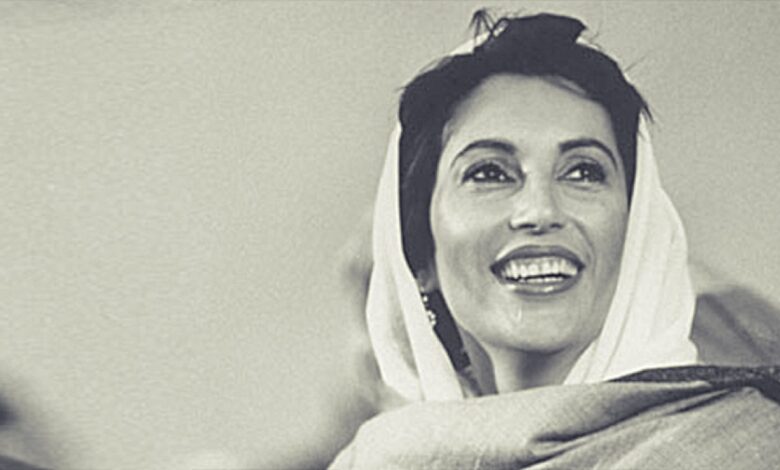
At the United Nations Fourth World Conference on Women, held in Beijing, the world’s representatives erupted in ovation as Benazir Bhutto, the prime minister of Pakistan at the time, took the podium. In 1995, Pakistani women continued to be ensnared in the web of patriarchy.
Shaheed Mohtarma Benazir Bhutto addressed some of the world’s most powerful leaders while wearing her trademark shalwar kameez and white dupatta. She stood erect at the podium. Her remarks conveyed her concern for women worldwide as she spoke with authority.
As the first elected female leader of an Islamic country, she said, “I feel a special responsibility towards all women.” This quote now sums up Benazir’s life and the fight she spearheaded in Pakistan to guarantee women’s rights.
Benazir of the Pakistan Peoples Party was a woman ahead of her time. She was a real lady, a role model for those women who could only dream of being empowered. Benazir promoted the idea that women should work in a nation where the majority of women are prohibited from leaving the house. She challenged the custom of dowries, which was a societal evil at the time, and promoted Islamic women’s rights. She felt that women should be treated with respect and given equal chances before they gained the courage to speak out against the injustices they experienced in a society where men predominated. That is how much Benazir Bhutto valued women’s rights.
Over the course of her life, Benazir came to represent hope for women everywhere. Upon taking office following the military dictatorship of Ziaul Haq, she aimed to reverse the harm he had caused by enacting laws that restricted the rights of women. Benazir frequently urged women to pursue education and careers in her talks, and she sincerely intended to alter the way Pakistanis view women.
She founded women’s studies centers at five universities in Islamabad, Karachi, Quetta, Peshawar, and Lahore after taking office in 1988. To meet women’s financial requirements, the First Women Bank was founded in the same year. Subsequently, the bank funded small-scale loan programs for underprivileged women.
Benazir also set aside a five percent quota for women in public sector jobs during her first term as prime minister to guarantee that women have access to employment possibilities. Even if this proportion might not seem sufficient, keep in mind that an ocean is made up of countless little drops of water. Millions of Pakistani women are employed today as a result of a job quota that was assigned for women during that period. Benazir also brought about changes in Sindh’s land reform sector by granting land ownership to landless women farmers.
When Benazir first came to power in 1993, she launched the Lady Health Workers Program and the nation’s first women’s police station. She oversaw the establishment of an Islamabad Working Women’s Hostel and a Ministry for Women’s Affairs. To keep women abreast of technological advancements, computer centers catering to women were also established.
The establishment of the Ministry of Women’s Development and the appointment of women to higher judiciary positions are two other measures implemented by Pakistan’s first female prime minister. Through the appointment of women to positions of influence and authority, these actions sought to have a lasting effect. Benazir also introduced a number of lending programs for female business owners.
Although Benazir achieved a lot while in government, others feel she could have done more. Many people, meanwhile, are unaware that Benazir took office following the start of a new phase of Islamization during Ziaul Haq’s autocratic rule. Being a woman-run nation at that time was an enormous achievement in and of itself.
For what it’s worth, Benazir made a significant contribution to the advancement of women’s standing in Pakistan. Ultimately, it was her responsibility to make the contentious Zari Sarfaraz Commission (1983–1985) documents public, which exposed the laws that discriminated against women.
Benazir’s brilliance, sensitivity, charisma, and leadership abilities set her apart from even the most prominent men throughout her life. Her determination to change the world, rather than her gender, was what set her apart from the others. Shaheed Mohtarma Benazir Bhutto’s commitment to improving women’s position in Pakistan is the reason why she is and always will be a beacon of hope for every Pakistani woman.