Pakistan must prepare itself amidst changing global geo-political and geo-economic situation: Experts

Dr Moeed W. Yusuf, the former National Security Advisor, has said that geographically Pakistan cannot escape from the great power contestation, as unipolarity is morphing into a new world order.
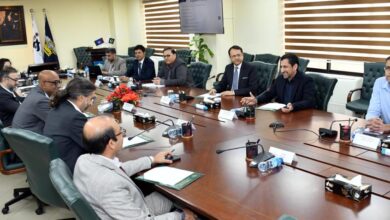
He was speaking at the morning plenary on the first day of 25th Sustainable Development Conference (SDC) organized by Sustainable Development Policy Institute (SDPI) and jointly held alongside UNESCAP’s 6th South and Southwest Asia High-level Political forum and Policy Dialogue on SDGs. The 4-day conference is being held in Islamabad from 5-8 December 2022.
Dr Yousaf said Pakistan can either become proxy ground for this contestation or emerge with a model where destabilized Pakistan is unfavorable for the world and we must move away from assistance to development partners. He said that Pakistan needs a strategy to send skilled labour to aging countries so as to increase remittances. He further suggested that Pakistan also needs to take bold policy choices, decentralize power to local governments and allow lateral entry of experts into revamp the government structure. He also stressed on deregulation and privatization of economic space, and prioritizing policy continuity in key governance areas through legal and constitutional guarantees.
Haroon Sharif, the former Chairman of Board of Investment, shedding light on four major challenges said that globalization is shifting towards regionalism and proximity advantage can cut the cost of trade – an opportunity Pakistan should not miss. Global tensions and conflicts are causing exogenous macro-economic shocks and share of nations in international organizations has become political leverage which is unfavorable for Pakistan’s bargaining positions. He suggested that amidst inflation, trade and partnerships diversification and regionalism can be the viable solutions. Emphasizing separating geo-economics from geo-strategic positioning, he said that the government should offer purely economic value by offering asset swaps so that the countries economic and investment interests could be interlinked.
Gen. (retd) Zubair Mahmood Hayat, the former Chairman of Joint Chiefs of Staff Committee, has said that geo-strategic contest of power at global level and regionally RSS-driven and BJP-led Bharat and associated Akhund Bharat ideology have serious geo-strategic ramifications for Pakistan. He said that it’s not pure geo-economics, but intertwined geo-strategy and geo-politics at play. He stressed the need for devising concrete policies to accelerate clean energy transition and exploiting blue economy to access unexplored markets. He suggested that moving forward, we need to explore digital, cyber and space technology and get in sync with states to diversify markets and capitalize human resources.
Dr Abid Qaiyum Suleri, the Executive Director of Sustainable Development Policy Institute (SDPI), said COVID-19 has decreased global GDP by US$10 trillion and continues to affect global trade and energy market. The conflict between Russia and Ukraine has challenged the agriculture market; G7 countries and EU have conflicts over hard choice between heating or eating, which has crowded global energy market.
He said the World Food Programme reckons the number of people facing acute food insecurity jumped from 282m at the end of 2021 to a record 345m in 2022 (an addition of 63 million in the last ten months). As many as 50m people will begin 2023 on the brink of famine. Until now, the problem has largely been spiraling prices rather than availability. In conflict zones such as Afghanistan, Ethiopia and Yemen, both farming and humanitarian aid is disrupted. Climate change means extreme weather events, like floods in Pakistan and drought in the Horn of Africa, are becoming more common, he concluded