NCRC and UNISEF launched Policy Brief on Child Domestic and Violent Discipline

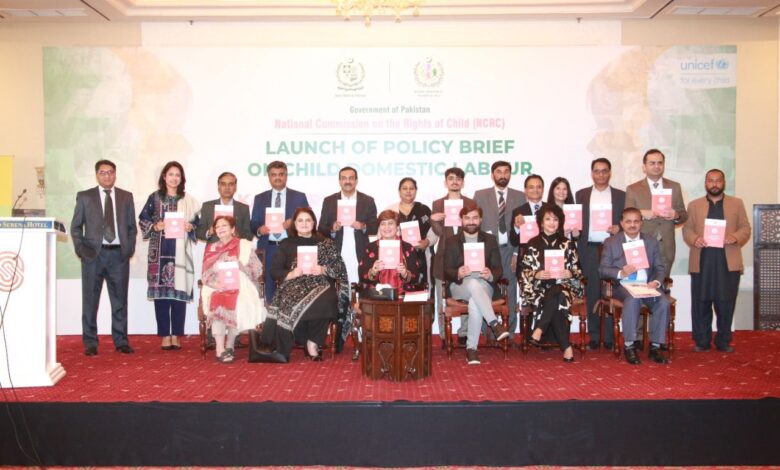
The National Commission on the Rights of Child (NCRC) in collaboration with UNICEF formally launched its Policy Brief on the Child Domestic Labour and KAP Survey on Child Labour and Violent Discipline on Tuesday, November 29, 2022 in Islamabad. The policy brief examines the issue of child domestic labour from a legal perspective primarily focusing on prevailing laws and enforcement mechanisms. Furthermore, it makes recommendations to legislators, policy makers, government agencies and development practitioners to address the issue of child domestic labour.
Ms. Afshan Tehseen, Chairperson of the National Commission on the Rights of Child (NCRC), explained critical role played by the Commission in addressing the menace of child labour and protecting the rights of children. She further stressed on the need for addressing loopholes in the existing laws on child domestic labour at the federal and provincial level. The Commission has played an important role in broadening the scope of Sindh Child Protection Authority Act 2011 by proposing amendments which were approved in April 2021. She also highlighted that the commission has handled more than 250 complaints of child rights’ violations giving direct relief. She further highlighted that many laws still lack implementation mechanisms and rules and the Commission is following-up with concerned departments at federal and provincial level.
NCRC presented the findings of the Policy Brief on the Legal Framework on Child Domestic Labour before the participants, highlighting the national and international commitments and gaps dealing with the issues of child domestic labour. NCRC shares that only extreme violent cases of child domestic labour are reported. The Commission welcomed the enactment of the Islamabad Capital Territory Domestic Workers Act in October 2022. According to this newly passed Act, employment of children in Islamabad Capital Territory under the age of 16 years is prohibited. This is in compliance with the Article 25 (A) of Pakistan’s constitution, and other provinces must also raise the minimum age for child labour to 16 years.
Ms. Daniela Luciani, Chief Child Protection UNICEF shared the findings of KAP (Knowledge, attitudes and Practices’) survey on Child Labour and Violent Discipline. Sharing the KAP findings and response from parents and children she highlighted that in Pakistan more than 12.5 million children, nearly 16% of the child population are known to be involved in child labour, with 13% to 14% of these children being aged 5 to 17 years. Moreover she added that an average of 34% of survey respondents reported that child labour can cause a child to feel inferior due to not being able to attend school. When listing the harmful consequences of child labour, an average of 27% adult respondents said child labour carries a risk of sexual abuse and exploitation. 42% of adult respondents reported that child labour carries a risk of physical abuse. Talking on violent discipline, she said that 81% of children in Punjab, 80% of children in Sindh, 82% of children in KP have experienced some sort of violence.
Ms. Rubina Khalid, Member of Senate-Pakistan remarked that every journey starts with little steps and awareness is the key to success. She mentioned that as long as market exists, child labour will be there so we need to create awareness that it’s a crime and make this a taboo. No doubt there is unemployment in the country but no one should be allowed to abuse a child. She further added that the media need to concentrate on the real issues. Furthermore, she suggested that people working on marginalized communities such as women empowerment, transgender and children rights should all work together towards a common goal.
Mr. Muhammad Wishaq, Joint Secretary, Ministry of Overseas Pakistanis & Human Resource Development (OP&HRD) discussed the role and effort of the OP&HRD ministry to eliminate child labour from Pakistan. He said Pakistan has ratified 36 ILO conventions including 8 out of 10 core conventions related to labour rights. He shared Government of Pakistan is giving top priority to tackle bonded/forced labour and child labour in coordination with all provincial governments. He commended that developmental partners inlcuding donors will generously contribute to eradicate the curse of child labour.
Ms. Faryal Javed, Child Member of NCRC stated that child participation is imperative to effectively combat child domestic labour. She further said there are 22.8 million children aged 5 to 16 years who are out of school and these children are surely engaged in some kind of child labour. She recommended that there is a need to train a group of children who can further assist in educating other children who are less privileged in the society.
Ms. Manizeh Bano, Executive Director SAHIL, quoted that NGOs can contribute little pieces to address the problem but it is the state who has to take up the responsibility. She said according to one of Sahil’s report, 1800 cases on child sexual abuse were reported last year and this year within six months (January to June 2022) more than 2000 cases were reported. This is an indication that people are taking up responsibility to report such cases so that action can be taken. She further added that education is the most important thing and major reforms are required in the country and the support provided by civil society should be linked with the national goal.
Mr. Tajdar Hashmi, Child Member NCRC gave a talk on ‘My Future: Country’s Future’. He said a lot of talks have been taking place but we need to start implementing and take matters seriously. He mentioned that he himself was homeless for some time and he got to see how things were from the lowest level. The government along with the civil society should make an immediate action plan to end this brutal reality of child labour which affects millions of children in Pakistan having no future.
The event was well attended by parliamentarians, government officials, and representatives from different embassies, UN Agencies, National and International NGOs, lawyers, boys scouts and girl guide associations and academia.