From Books to Tools: The Tragic Tale of Child Labor in Pakistan

The global day for the elimination of child labor has arrived, observed annually on June 12. As usual various social organizations will gather in air-conditioned rooms of big hotels to discuss the issue and express sympathy for children.
However, if only someone could step out of those cool rooms to give the children a beautiful day.
I had to make a report so I went to Khadda Market in G-7, Islamabad. I had passed by this market before but never went inside. The scorching heat and hot winds were harsh reminders of the tough weather but I had to ignore the weather’s severity for the sake of my report. The market was nearby but I never imagined the myriad of broken-down vehicles and the countless children working there as mechanics.
These children having adopted the profession of mechanics were engrossed in their work. It was clear at a glance that child labor is increasing day by day. Moving forward I met a small boy named Fazal Abbas approximately eight or ten years old. I sat down next to him while he continued working. When I greeted him he responded with a smile. Our conversation left me saddened. When I asked how long he had been working he replied that he had been there for three months. I asked how much he earned in a day and he said only 100 rupees a day. I asked if he had a desire to study and why he didn’t go to school. He replied that he had no interest in studying and just wanted to earn money. When I asked what he wanted to become when he grew up, he said he would open a shop but didn’t want to study. I insisted and asked if anyone had forced him to work, and he said no, he worked of his own will because he didn’t like studying.
I moved forward and talked to another boy Arslan Shah who was also around eight to ten years old. I asked him who had sent him to work. He said his parents had passed away and his aunt had sent him to work telling him to earn money now. This boy had a dream of becoming a soldier when he grew up. When I spoke to the person training these children as mechanics he said most of these children are left here by their parents or relatives due to poverty,hoping they will learn some skills. He blamed the government which makes promises but takes no action. He said the government needs to think seriously about this. The truth is if the government were serious it wouldn’t be that difficult. But the ever-increasing inflation has made even one meal a day difficult for those living in poverty.
I moved forward and spoke to another 14-year-old boy named Ehsan, who was busy fixing a car. This hardworking and dedicated boy also said he had no interest in studying and just wanted to work and earn money. Everywhere, children adopting the profession of mechanics were seen working in this heat. I headed towards Aabpara Market, where many children were waiting for a car to clean. I met a Pashtun boy named Khizam, about 11 years old. He said he had been cleaning cars there for two years. His father had been unable to work since an accident, so necessity had taken away his books and bag. He had dropped out of school after third grade. When I asked what he wanted to become when he grew up and what his dreams were, he responded with sadness and despair that he had no dreams left. His dreams had already been shattered, and now he just wanted to earn a lot of money.
When I moved from Aabpara to G-9, I saw children waiting at the traffic signal, some cleaning cars and some begging. The people in the stopped cars refused them with bitter and disdainful looks, thinking they were part of a mafia. The question is if these children of the future are part of a mafia, who made them so? Who is training this mafia? In my opinion, the biggest mafia is the ruling class, the ministers, and the country’s contractors sitting in the parliament.
We have been hearing since childhood that if you study, you will become a king. But even in Pakistan, especially in Islamabad, many children are deprived of education and are working as laborers. A few months ago, a report was published based on a 2021-2022 survey, stating that 26.2 million children in Pakistan are deprived of school. In Punjab, there are 11.73 million, in Sindh, 7.63 million, in KPK, 3.63 million, and in Balochistan, 3.13 million children deprived of education. In the federal capital, Islamabad, 800,000 children are not going to school, and 39% of these children are not attending school due to various reasons such as unemployment, poverty, and inflation.
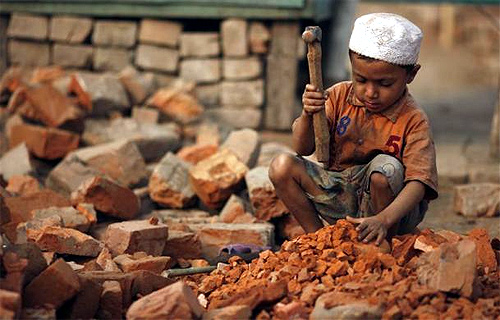
If actions were taken based on this data, these children wouldn’t be seen working as laborers. Seeing the despair in children in Islamabad today broke my heart. The candles of hope have already been extinguished. Who is responsible for this? Children aged eight to ten and twelve to fourteen are working as mechanics, washing cars, or begging. Who is responsible for this? Today, these children’s eyes do not hold dreams of a bright future but the fear of hunger and poverty. Instead of books, they hold tools, rods, wipers, and cloths in their hands, learning a different lesson of life—that to quell their hunger, they must work hard because the rulers cannot feel the helplessness of the poor from their air-conditioned rooms.
In the scorching heat of the afternoon these children ignoring the harsh weather are certainly waiting for someone kind to change their lives. These children, fighting poverty every day, are whose responsibility? The increasing inflation suggests a dangerous rise in child labor in the future, but the government and social organizations must act before that happens. If social organizations did something, child labor would at least reduce somewhat. Saving this generation of Pakistan and providing them with awareness is the responsibility of the government and organizations. Remember them in your prayers.